
Article
Coffee Grind Size Chart: 8 Common Brew Methods
- Researched — Hands-on testing has not been completed for this page; it reflects research and category best practices.
- Report a correction — fixes are logged in the Updated date.
If you own more than one coffee brewer, grind advice can get confusing fast. One guide says “medium,” another says “medium-fine,” and your grinder may use numbers that mean nothing on a different machine.
The clearest way to think about grind size is this: use the brew method to choose a starting range, then dial in from there.
There is no universal grinder setting that is correct for every bean, grinder, filter, dose, and recipe. Even manufacturers that publish grind charts treat their recommendations as starting points. Your final setting depends on how the coffee flows and, most importantly, how the cup tastes.
Quick Grind Size Chart
| Brew method | Starting grind |
|---|---|
| Espresso | Fine |
| Moka pot | Medium-fine |
| AeroPress | Medium-fine |
| V60 / cone pour-over | Medium-fine |
| Automatic drip | Medium |
| Chemex | Medium-coarse |
| French press | Coarse |
| Cold brew | Coarse |
The chart is a starting map, not a rulebook. If your brewer behaves differently, trust repeatable brew results over a label like “medium.”
Why Grind Size Changes Coffee
Grinding coffee changes how much surface area the water can reach and how quickly soluble material can move out of the coffee particles.
In general, finer coffee extracts faster. Coarser coffee extracts more slowly. Peer-reviewed immersion-brewing research has found that smaller particles can increase extraction rate under controlled conditions, while espresso research also shows that particle size materially changes extraction kinetics.
But grind size does more than change extraction speed. In many brewers it also changes water flow.
With espresso, for example, a finer grind creates more resistance and usually slows the shot. A coarser grind usually speeds it up. In pour-over brewing, very fine grounds and fines can also slow drawdown or contribute to a stalled filter.
That is why “fine extracts more” is useful, but incomplete. A cup is affected by grind size, coffee dose, water amount, temperature, contact time, agitation, filter, roast, grinder quality, and the coffee itself.
Use grind as one control, not the only control.
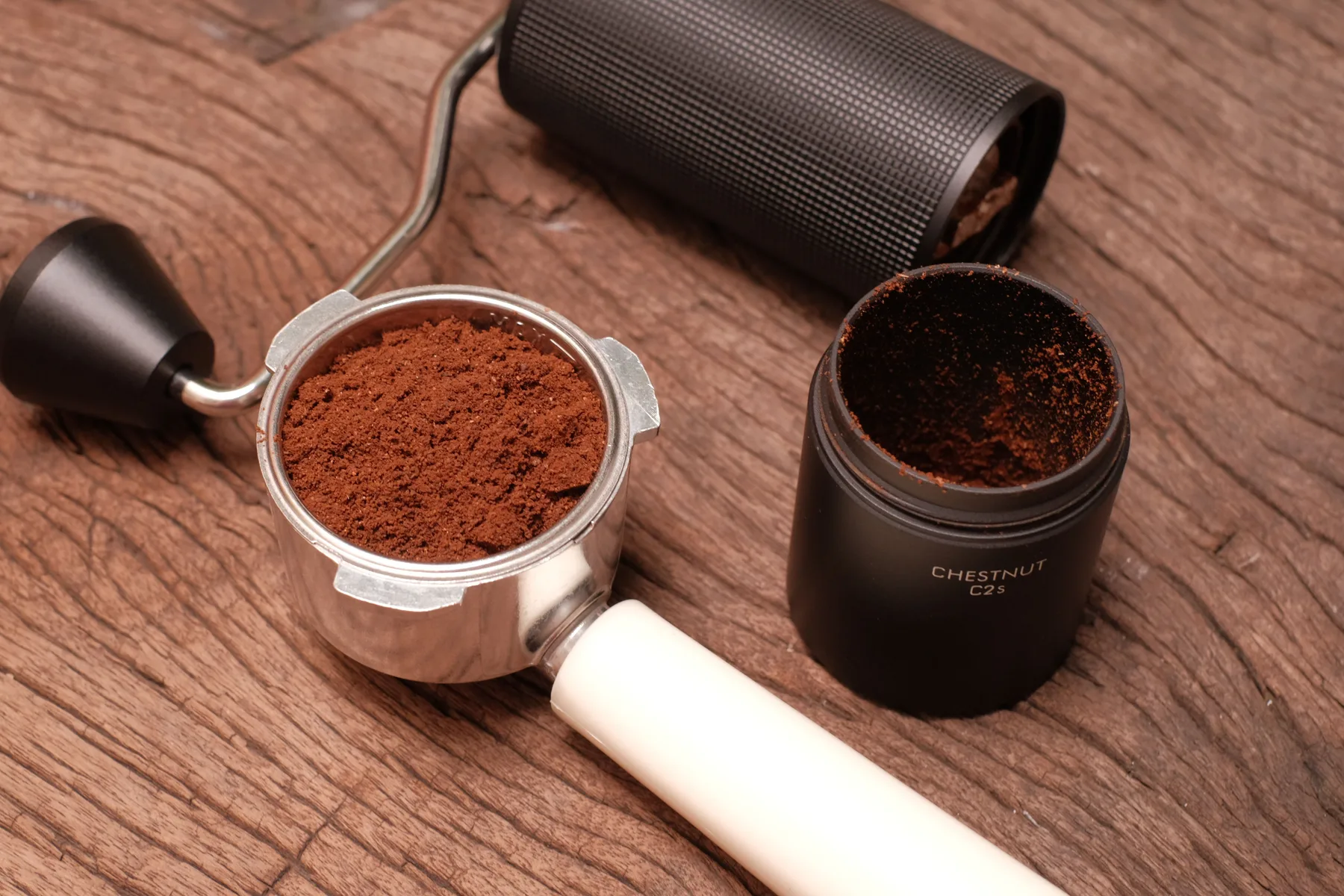
Espresso: Start Fine
Espresso needs a fine grind because the brew happens quickly under pressure.
A practical starting point is a fine, salt-like grind that allows the shot to flow in the intended range for your recipe. Breville’s espresso guidance gives the simple relationship that matters most when dialing in: grinding finer slows the flow, while grinding coarser speeds it up.
If the shot gushes through unusually fast and tastes thin or sharp, move finer in small steps. If the machine chokes, the shot barely moves, or the cup becomes harsh and overly extracted, move coarser.
Do not copy somebody else’s grinder number unless you own the same grinder and understand that calibration can still differ. “Setting 8” on one grinder may have no meaningful relationship to “setting 8” on another.
Moka Pot: Start Medium-Fine
A moka pot is not an espresso machine, even though it makes concentrated coffee.
Bialetti recommends a medium-fine grind for its moka brewers and gives a useful tactile description: the grounds should feel gritty rather than powdery. Bialetti also warns that coffee ground fine for an electric espresso machine may be too fine and can obstruct the brewer.
That makes medium-fine a better starting point than true espresso-fine.
If your moka pot struggles to brew normally, do not automatically pack the basket harder or grind finer. The coffee should be placed loosely in the funnel according to the brewer’s instructions.
AeroPress: Start Medium-Fine
AeroPress gives one of the clearest manufacturer grind scales available.
Its recommended default is medium-fine: finer than standard drip coffee and coarser than true espresso. AeroPress explains that this range helps control drip-through without making the press unnecessarily difficult to push.
If a large amount of water runs through before you begin pressing, AeroPress recommends going finer after first checking that the bed is level and the pour is controlled. If the press becomes too difficult, an overly fine grind or excess fines may be part of the problem.
AeroPress is unusually flexible, so individual recipes can move much finer or coarser. Treat medium-fine as the baseline, not the boundary.
V60 and Cone Pour-Over: Start Medium-Fine
For a standard V60 recipe, medium-fine is a useful starting point.
Hario USA hosts several V60 recipes that use medium-fine grinding, including recipes associated with James Hoffmann and Camber Coffee. But V60 recipes vary widely because pouring pattern, dose, filter, brewer size, roast, and desired drawdown all affect the result.
Watch the brew, not just the grinder dial.
If water races through and the cup tastes thin, hollow, or sharply sour, try a slightly finer grind while keeping the rest of the recipe stable. If drawdown becomes extremely slow, the filter stalls, or the cup tastes harsh and drying, try slightly coarser.
A key Coffee Made Clear rule: change one thing at a time. If you change grind, temperature, ratio, and pouring technique together, you will not know which change improved the cup.
Automatic Drip: Start Medium
Most automatic drip brewers are designed around a middle-range grind.
A medium grind is a sensible default because it provides enough resistance and extraction for typical machine flow without creating the compact bed used for espresso.
Large batch brews, darker roasts, or specific basket shapes can push the ideal setting somewhat coarser. Smaller batches or other recipes may move finer.
Again, the goal is not to force every drip brewer into the word “medium.” The goal is to start in the middle and then make controlled adjustments.
Chemex: Start Medium-Coarse
Chemex is one place where treating every pour-over the same can cause trouble.
Chemex itself recommends a medium-coarse grind. Its FAQ connects that recommendation to extraction and flow rate.
That matters because Chemex filters are different from a typical V60 setup. If you simply copy a fine V60 setting, the brew may run much slower than intended.
Start medium-coarse. If the brew is too fast and weak, move a little finer. If it drains very slowly or the cup becomes heavy, harsh, or astringent, move a little coarser after confirming that the filter and pour setup are correct.
French Press: Start Coarse
French press coffee is an immersion brew with several minutes of contact time and a metal filter.
A coarse, even grind is the conventional starting point. Baratza specifically emphasizes evenly coarse coffee for French press, while Breville also places French press in the coarse range.
Coarser grounds can make plunging and separation easier and fit the longer immersion time.
That does not mean finer French press recipes are impossible. It means coarse is the most useful baseline for a beginner chart. For example, the Prima Coffee Equipment recipe used in our French press guide starts one step finer, at medium-coarse.
Cold Brew: Start Coarse, Then Match the Recipe
For the traditional long-steep home cold-brew method, coarse is the most practical starting point.
That advice is common in grinder and brewer education because cold brew typically uses long contact times and later filtration.
There is an important nuance, though. Controlled research on immersion cold brewing has shown that finer particles can increase extraction rate. So “cold brew must always be coarse” is too absolute.
For a simple home workflow, start coarse because it is easy to filter and forgiving over a long steep. If you intentionally change grind finer, you may also need to change steep time, filtration, or other variables.
The Coffee Made Clear One-Change Grind Method
A grind chart gets you into the neighborhood. This method is how you find the house.
Step 1: Pick the starting range.
Use the chart for your brewer. Do not worry about finding a supposedly perfect grinder number before you brew.
Step 2: Keep the rest of the recipe stable.
Use the same dose, water amount, water temperature, and basic technique for the next comparison whenever practical.
Step 3: Brew and observe two things.
Notice how the water or shot flows, and then taste the coffee.
Step 4: If it is too fast and tastes thin, sharp, or sour, test slightly finer.
This is a first troubleshooting move, not a diagnosis. Other variables can cause similar flavors.
Step 5: If it is too slow, stalls, or tastes harsh, drying, or bitter, test slightly coarser.
Again, this is a controlled first test, not proof that grind was the only problem.
Step 6: Change one grind step at a time.
Small changes teach you more than large jumps.
Step 7: Brew again before changing something else.
If the cup improves, keep moving carefully in that direction until the improvement stops.
Step 8: Once grind is close, evaluate the other variables.
Temperature, ratio, agitation, contact time, water, roast, freshness, and filter behavior may be the next controls to adjust.
Why This Method Works Better Than Copying Grinder Numbers
Grinder numbers look precise, but they often create false confidence.
Grinder numbers are model-specific rather than universal measurements, so a dial number from one grinder should not be treated as directly transferable to a different grinder. Beans and recipes also change, which is another reason to use grind categories as starting references rather than promises of a fixed result.
A brew method category is therefore more portable than a grinder number:
Fine tells you the espresso neighborhood.
Medium-fine gets you near moka, AeroPress, and many pour-over recipes.
Medium starts most automatic drip brewers.
Medium-coarse fits Chemex well.
Coarse starts French press and conventional cold brew.
Then the cup tells you where to go next.
Simple Troubleshooting Table
Problem: espresso or filter brew runs much too fast
First grind test: finer
Keep stable: dose, water, basic recipe
Problem: pour-over or espresso runs much too slowly
First grind test: coarser
Also inspect: excess fines, filter behavior, puck prep, agitation
Problem: cup is thin, weak, or sharply sour and brew also ran fast
First grind test: finer
Caution: water temperature, ratio, roast, and technique can also matter
Problem: cup is harsh, drying, or bitter and brew also ran unusually slow
First grind test: coarser
Caution: temperature, time, ratio, and roast can also matter
Problem: you changed the grind and cannot tell what happened
Fix: return to the last known setting and change only one variable
The Most Important Rule
Do not chase the label on the grinder. Chase a repeatable cup.
“Medium-fine” is useful because it gives you a starting direction. It is not a specification that guarantees good coffee.
The practical sequence is:
Choose the brew method.
Start in the recommended range.
Brew the same recipe.
Watch the flow.
Taste.
Move slightly finer or coarser.
Repeat.
That is enough structure for a beginner to improve without turning coffee into a laboratory project.
Save This Reference
Quick starting ranges:
Fine — espresso
Medium-fine — moka pot, AeroPress, many V60 recipes
Medium — automatic drip
Medium-coarse — Chemex
Coarse — French press, conventional cold brew
Then use the Coffee Made Clear One-Change Grind Method to dial in from there.
Sources
Studies and pages used for the claims above. This guide is research-based and does not claim hands-on product testing.
- Kuhn et al., Time-resolved extraction of caffeine and trigonelline from finely-ground espresso coffee with varying particle sizes and tamping pressures, Journal of Food Engineering (2017).
- Wang and Lim, Effects of grind size, temperature, and brewing ratio on immersion cold brewed and French press hot brewed coffees, Applied Food Research (2023).
- AeroPress, grind size guidance and how-to-use page.
- CHEMEX, Classic Series product support and FAQ.
- Hario USA, James Hoffmann V60 technique and V60 recipe with Camber Coffee.
- Bialetti, Moka Express product page.
- Breville, espresso recipe, how to use a coffee grinder and coffee brewing methods.
- Baratza, shop by brew method.
Editorial source note
This guide was built from current manufacturer guidance from AeroPress, CHEMEX, Hario USA, Bialetti, Breville, and Baratza, plus peer-reviewed research on grind size and extraction. It does not claim that Coffee Made Clear personally tested the brewers or grinders discussed. The publication scope is intentionally limited to eight common methods with stronger supporting sources.