
Article
Light vs Medium vs Dark Roast
Edited and reviewed by Coffee Made Clear TeamUpdated 7 min read
Roast labels are useful directions, not fixed standards.
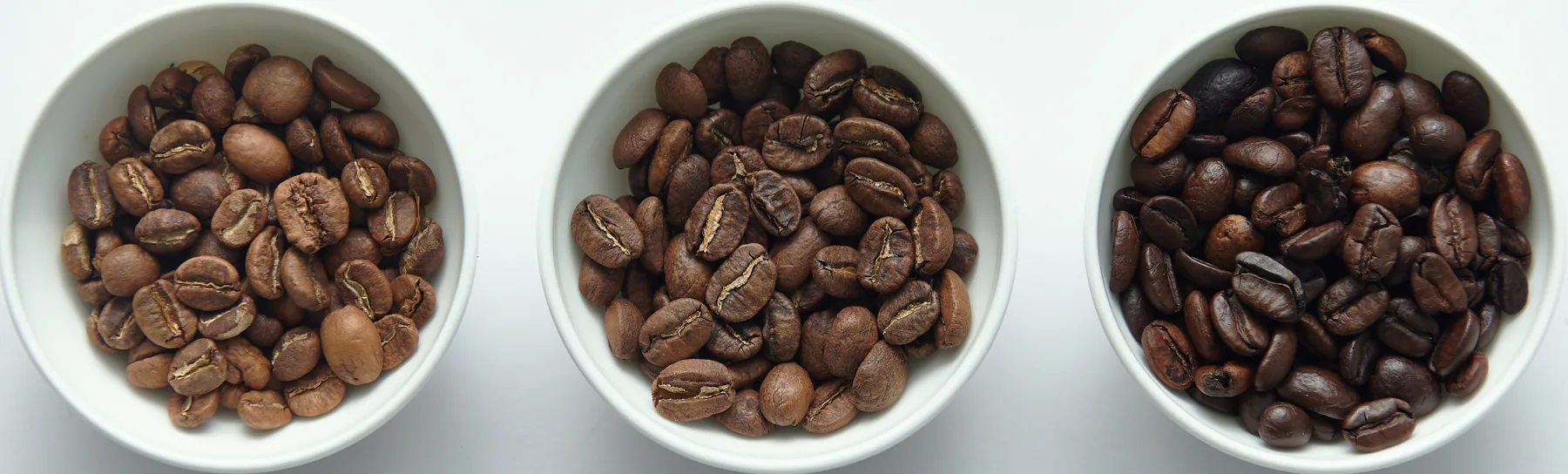
Light roasts usually show more origin character and brightness; dark roasts more roast character, bitterness and smoky notes; medium sits between. Start from the cup you want, then use the Roast Compass below to choose a direction.
Two roasters can label similar beans differently, so compare roasts within one roaster when you can. And the roast name is a poor guide to caffeine.
Coffee bags make roast level sound simple: light, medium, dark. But those three words are broad labels placed on a continuous roasting process, not three universal boxes. They are still useful. Roast degree is measurable, and controlled research shows it can strongly change color, chemistry and flavor.
In this guide we explain what the labels can and cannot tell you, what tends to change in the cup, and why roast is a poor caffeine shortcut. Then we give the Roast Compass, two questions that turn “which roast is best?” into “which roast direction suits the cup I want?”
Roast is a continuum, not three boxes
Coffee gets darker as roasting goes on, and tools can measure that. The industry has long used roast-color analyzers such as Agtron, and researchers also use CIELAB color measurements. The Specialty Coffee Association notes that clear standards for the roast names are lacking, and that many roasters still classify roasts by eye.
In SCA research comparing three origins at light, medium and dark roast, roast caused the largest differences in color. The words themselves are flexible, though. One peer-reviewed study noted that its own “medium” roast overlapped with what some earlier research called “light.” The National Coffee Association adds that one roaster’s dark roast may differ from another’s, and that most roasters use their own names.
So when two bags both say “medium,” do not assume they were roasted to the same point. Treat the label as a direction, not a specification.

What usually changes in the cup
Roast degree is one of the strongest flavor variables in coffee. In a 2024 UC Davis study, roast level was the largest driver of differences among its samples: the darker roast scored higher for bitter, burnt, smoky and roasted notes, and the lighter roast for sour, citrus and berry notes. Other controlled studies show the same trend.
The National Coffee Association puts it in plain terms: lighter roasts preserve more of a coffee’s unique qualities and are more acidic, and dark roasts have an oily surface and a pronounced bitterness.

These are trends, not promises. The studies used particular origins, roast profiles and brewing methods. A developed light roast can taste sweet rather than sour, and a carefully roasted dark coffee can taste rich rather than burnt. Origin, processing, the roast profile and your brewing still matter.
Roasting changes chemistry too. Chlorogenic acids, for example, decline as roast degree increases. That is chemistry context only; this guide makes no health claim for any roast.
Caffeine: neither shortcut works
“Dark roast has more caffeine” and “light roast has more caffeine” are both unreliable.
A 2021 study found no statistically significant caffeine difference across its light, medium and dark roast groups. A 2024 brewing study showed why the answer can flip. Brewed the same way, its darker roasts generally gave less caffeine than the lighter ones. Compared at the same extraction yield, the darker roasts generally had more. The authors said no universal conclusion could be drawn.
A dark roast can taste “stronger” because it is more bitter and roasty, but that is not the same as more caffeine. If caffeine matters to you, the dose, the coffee and the serving size are better things to track than the word on the bag.
The Roast Compass
The Roast Compass uses two decisions.
- Origin expression or roast expression. Do you want fruit, floral or regional character to lead, or toasted, cocoa, smoky, roast-driven character?
- Black or with milk. Will you usually drink it black, or do you want the coffee to stay noticeable through milk?
| Your direction | Starting roast | Why it is a starting point |
|---|---|---|
| Origin expression, usually black | Light to medium-light | Less roast character leaves more room for origin differences |
| Balanced, usually black | Medium | Often combines sweetness, body and moderate roast character |
| Balanced, often with milk | Medium to medium-dark | More roast character may stay noticeable after milk dilutes the cup |
| Roast expression, black or with milk | Dark | Smoke, bitterness and roast-derived flavors lead |
These are tendencies, not quality rankings, and the compass is our editorial tool, not a scoring system. Brew quality and the green coffee still matter. Caffeine is deliberately not one of the questions: as above, roast is a poor guide to it.
Not sure yet? Start in the middle of one roaster’s range, then move lighter or darker one bag at a time.
You can also answer the two questions here. The quiz uses the same table and runs in this page only; it does not save or send your answers.
Find your starting roast
Answer the compass’s two questions. It points to a starting roast direction from the table above. It is a direction to taste, not a ranking of roasts.
How the Roast Compass chooses
Your two answers pick one row of the compass table. Roast expression starts dark, black or with milk. Balanced starts at medium when black, and at medium to medium-dark with milk. Origin expression starts at light to medium-light when black. The compass has no row for origin expression with milk, so it shows the origin-black row and the balanced-with-milk row and suggests tasting both. Caffeine is not a question, because roast is a poor guide to it.
Read the bag after choosing a direction
Use the roast name as one clue. Then check the tasting notes, origin, process and the roaster’s own description. Because the labels are not tied to one color or roast endpoint, comparing roasts within one roaster is more reliable than comparing labels across several. Our guide to reading a coffee bag walks through each part of the label.
Worked example
Frequently asked questions
Is light roast more acidic than dark roast?
Usually, yes. The National Coffee Association says the lighter the roast, the more acidic the brewed coffee, and that dark roasts are less acidic still. Trained tasting panels have found the same trend.
Does dark roast have more caffeine?
Not reliably. One study found no significant caffeine difference between its roast groups, and another found the answer flips depending on whether you compare brews made the same way or at the same extraction. Track your dose instead.
Is medium roast the same at every roaster?
No. There is no single standard for the labels, and the National Coffee Association notes that one roaster’s dark may differ from another’s. Compare roasts within one roaster.
Which roast is best for milk drinks?
Many people find more roast character stays noticeable through milk, so medium to medium-dark is a common starting point. It is a direction to test, not a rule.
- Light, medium and dark are broad directions, not fixed standards; two roasters can label similar beans differently.
- Lighter roasts tend to keep more origin character and acidity; darker roasts more roast character, bitterness and smoke.
- The Roast Compass asks two questions: origin or roast character, and black or with milk.
- Roast level is a poor guide to caffeine, so do not choose a roast for that.
Sources
Studies and pages used for the claims above.
- Specialty Coffee Association, What Color is Your Coffee?.
- Specialty Coffee Association, The Color in Your Cup: Roast Level and Brew Temperature Significantly Affect the Color of Brewed Coffee.
- Yeager et al., Roast level and brew temperature significantly affect the color of brewed coffee, Journal of Food Science (2022).
- National Coffee Association, Coffee roasts guide.
- Batali et al., Sensory Analysis of Full Immersion Coffee: Cold Brew Is More Floral, and Less Bitter, Sour, and Rubbery Than Hot Brew, Foods (2022).
- Liang et al., Sensory analysis of the flavor profile of full immersion hot, room temperature, and cold brewed coffee over time, Scientific Reports (2024).
- Specialty Coffee Association, Modulating Perception.
- Rune et al., Acids in brewed coffees: Chemical composition and sensory threshold, Current Research in Food Science (2023).
- Awwad et al., Quantification of Caffeine and Chlorogenic Acid in Green and Roasted Coffee Samples Using HPLC-DAD and Evaluation of the Effect of Degree of Roasting on Their Levels, Molecules (2021).
- Lindsey et al., Caffeine content in filter coffee brews as a function of degree of roast and extraction yield, Scientific Reports (2024).
Published Updated
See sourcesReport a correction — fixes are logged in the Updated date.