
Article
How to Descale a Coffee Maker
Edited and reviewed by Coffee Made Clear TeamUpdated 6 min read
Hard water carries calcium and magnesium. When it is heated, it leaves a mineral layer called scale.
Moccamaster says scale can slow the flow and affect the brewing temperature. Descaling dissolves it.
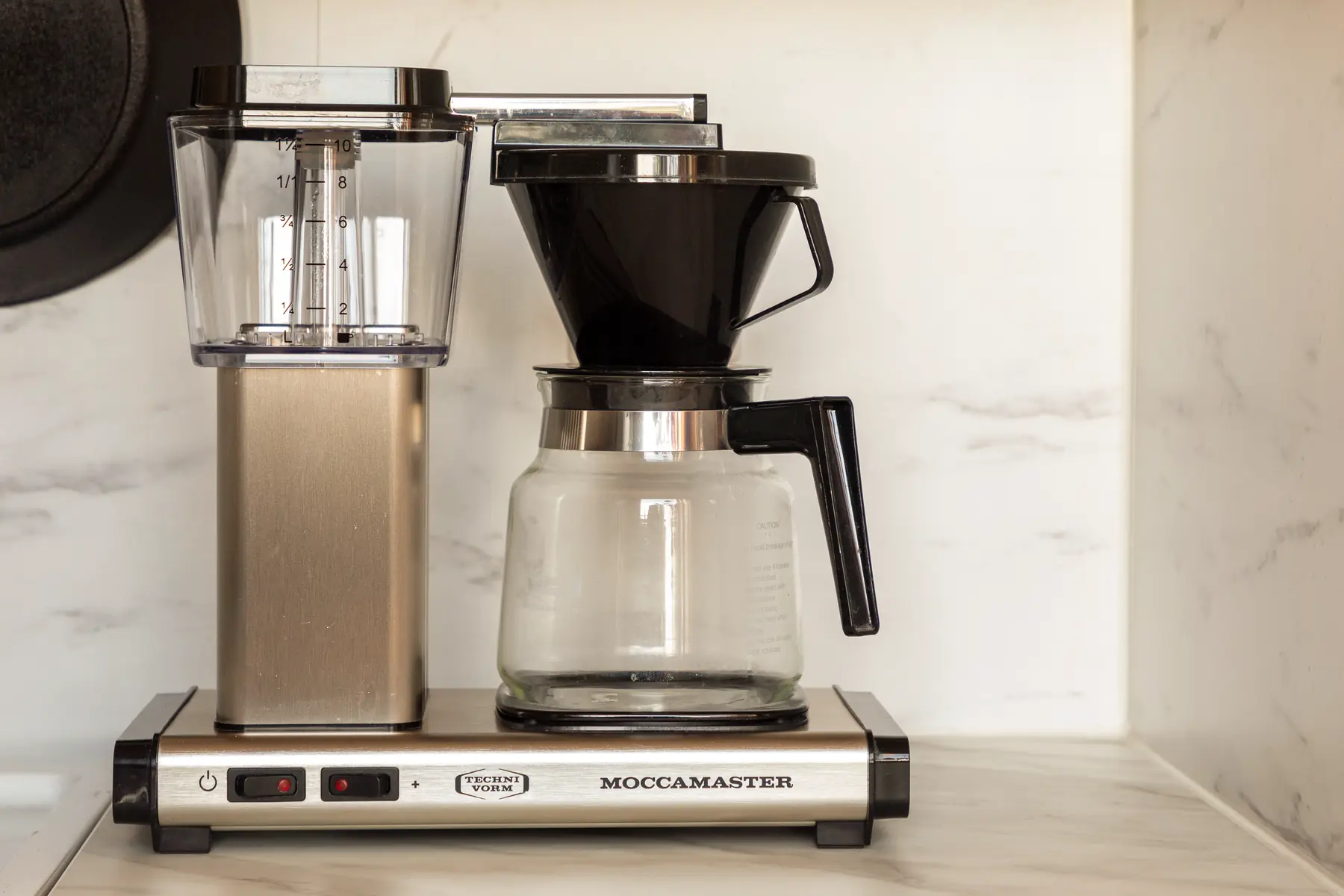

Moccamaster suggests descaling about every 100 brews, and more often with hard water; that is our default too. Makers disagree about vinegar: Moccamaster says it is not strong enough, Philips allows it. So use the descaler your own manual names. If it names none, our default is a descaler made for coffee makers, mixed as its label says (Moccamaster dissolves its powder in 32 oz of warm water). Then rinse with clean water until nothing of it remains.
If your coffee maker is getting slower, or your kettle has a mineral crust inside, the cause is often scale. It builds up from the minerals in hard water, and it does not go away on its own.
In this guide we explain where scale comes from, how to find out how hard your water is, and how to descale safely. We also explain why the advice on vinegar differs between makers.
Scale and hard water
What scale is
Water hardness is the amount of calcium and magnesium dissolved in it. When hard water is heated, solid deposits of calcium carbonate can form. That crust is scale.
The U.S. Geological Survey notes that scale can shorten the life of equipment and make heating less efficient. A coffee maker heats water every time you brew, so scale builds up inside it.
How hard is your water?
Hardness is measured in milligrams per liter (mg/L) as calcium carbonate. The U.S. Geological Survey uses these bands:
| Hardness | mg/L as calcium carbonate |
|---|---|
| Soft | 0–60 |
| Moderately hard | 61–120 |
| Hard | 121–180 |
| Very hard | more than 180 |
For your own water, ask your water supplier. In the U.S., community water suppliers must send customers a water quality report each year by July 1, and the EPA has a search tool for finding yours.
Why and how often to descale
What scale does to a coffee maker
Moccamaster explains that minerals build up on the heating element as scale. That buildup can slow and eventually stop the flow of water. It can also affect the brewing temperature and how long the water stays in contact with the coffee. Left long enough, the maker says, it can permanently damage the brewer.
How often to descale
Follow your manual first. Moccamaster suggests descaling about every 100 brews, or whenever you finish a box of filters. It adds that scale builds up faster with harder water, so you should descale more often. Philips simply says to descale regularly, without a fixed interval.
Our default, if your manual gives no interval: about every 100 brews. At one pot a day, that is about every 3 months, by our arithmetic. Descale sooner if your water is hard (above 120 mg/L) or the brew starts to slow.
Vinegar or descaler?
Here the makers disagree, so there is no single right answer; “Where sources disagree”, after the steps, sets out each view.
Our default, if your manual names none: a descaler made for coffee makers, mixed as its label says. Moccamaster dissolves its descaling powder in 32 oz (about 950 ml) of warm water. Use vinegar only if your manual allows it.
What you need
- Your coffee maker’s manual.
- The descaler your manual names, or white household vinegar if your manual allows it.
- Fresh water for rinsing.
Water hardness and descaling
- Soft
- 0–60 mg/L
- Moderately hard
- 61–120 mg/L
- Hard
- 121–180 mg/L
- Very hard
- more than 180 mg/L
- Default interval
- about every 100 brews (Moccamaster), or about every 3 months at one pot a day
- Harder water
- descale more often
- Default solution
- a descaler made for coffee makers, mixed as its label says; Moccamaster dissolves its powder in 32 oz (about 950 ml) of warm water
- Vinegar
- only if your manual allows it; Philips uses white household vinegar (4% acetic acid) undiluted
- Rinse
- until the water no longer tastes or smells of it
Your maker's manual comes first for how often and with what. Our default is for when your manual names none. Hardness is measured as calcium carbonate.
Step 1: Check your manual
Find the descaling section. Note which descaler it names, how much to use, and whether it allows vinegar.
Step 2: Empty the machine
Remove any coffee, filter and leftover water. Use a clean paper filter if your manual says to.
Step 3: Fill with the descaling solution
Mix the descaler as your manual says. If it gives no amount, follow the descaler’s label; Moccamaster dissolves its powder in 32 oz of warm water. Use vinegar only if your manual allows it.
Step 4: Run the descaling cycle
Run the machine as your manual describes, with the solution in the water tank.
Step 5: Rinse with clean water
Run fresh water through it several times. Moccamaster suggests three cycles; Philips says to repeat until the water no longer tastes or smells of vinegar.
Step 6: Note the date
Write down when you descaled, so you know when the next one is due.
Safety. A coffee maker and the solution in it can be hot, and hot water and steam cause burns and scalds. Let the machine and carafe cool before you handle them, and keep the steam and spout away from your face and hands. For a descaler, follow the product label and its safety data sheet, wear gloves or eye protection if the label says so, and never mix cleaning products. Keep descaler and vinegar away from children, and rinse the machine thoroughly afterward. Follow the descaling steps in your maker’s own manual.
Where sources disagreeVinegar or commercial descaler
The question
Should you descale a coffee maker with vinegar or a commercial descaler?
CMC verdict
Your machine's manual decides. Use the product and strength it names. If it rules out vinegar, do not use it. If it allows vinegar, follow its dilution and rinse steps exactly.
Try it yourself
Do not run different acids through the same machine to compare them. Instead, note the date, your water hardness, the product you used, and whether the brew time improves after the manual's procedure.
See the sources
Source A
Moccamaster
Vinegar is not strong enough to break down mineral buildup, and it can leave an odor and aftertaste. Moccamaster recommends a descaling powder.
Source B
Philips
Its listed coffee makers can use any liquid descaler or white household vinegar (4% acetic acid), filled into the tank undiluted, followed by three tanks of fresh water. It advises against powder descalers and tablets, which could harm the inside of its machines.
Why they differ
The machines, their internal materials and their cleaning programs differ. Advice that is right for one model can leave an odor, fail to remove scale, or go against another maker's instructions.
Sources for this section
Troubleshooting
The coffee tastes of vinegar or descaler
Run more cycles of fresh water until the taste and smell are gone.
The brewer is still slow after descaling
Try one more descaling cycle. If the flow is still slow, check your manual or contact the maker.
My water is very hard
Expect to descale more often than the manual’s basic interval. Our coffee water guide explains how minerals also change the taste.
Frequently asked questions
Can I descale a coffee maker with vinegar?
It depends on your machine. Philips allows white household vinegar (4% acetic acid), used undiluted. Moccamaster says vinegar is not strong enough to break down scale. Check your manual and use what it names.
How often should I descale my coffee maker?
Follow your manual. If it gives no interval, use our default: about every 100 brews, as Moccamaster suggests, or when you finish a box of filters. At one pot a day that is about every 3 months; descale more often if your water is hard.
How do I know if I have hard water?
Ask your water supplier; its annual water report may list it too. Hardness is given in mg/L as calcium carbonate: above 120 is hard, and above 180 is very hard.
What happens if I never descale?
Scale keeps building. Moccamaster says it can slow and eventually stop the flow of water, and can permanently damage the brewer.
- Scale is the mineral layer that hard water leaves when it is heated.
- Moccamaster says scale can slow the flow and affect brewing temperature. Our default: about every 100 brews, and more often if your water is hard.
- Makers disagree about vinegar. Use the descaler your own manual names; if it names none, use a descaler made for coffee makers, mixed as its label says.
- Rinse with clean water afterwards until the water no longer tastes or smells of the descaler.
Sources
Pages used for the claims above.
- U.S. Geological Survey, Water Science School, Hardness of Water.
- U.S. Environmental Protection Agency, CCR Information for Consumers.
- Moccamaster USA, How to Descale Your Moccamaster Coffee Brewer.
- Philips Support, How to descale my Philips Coffee Maker?
Published Updated
See sourcesReport a correction — fixes are logged in the Updated date.