
Article
How to Make Cold Brew at Home
Edited and reviewed by Coffee Made Clear TeamUpdated 7 min read
Stir 60 g of coarse coffee into 700 g of cool water and leave it covered for about 14 hours.
That is about 1:11.7, and room-temperature water works too. Strain it, keep it in the fridge, and taste it before you add water, milk or ice.
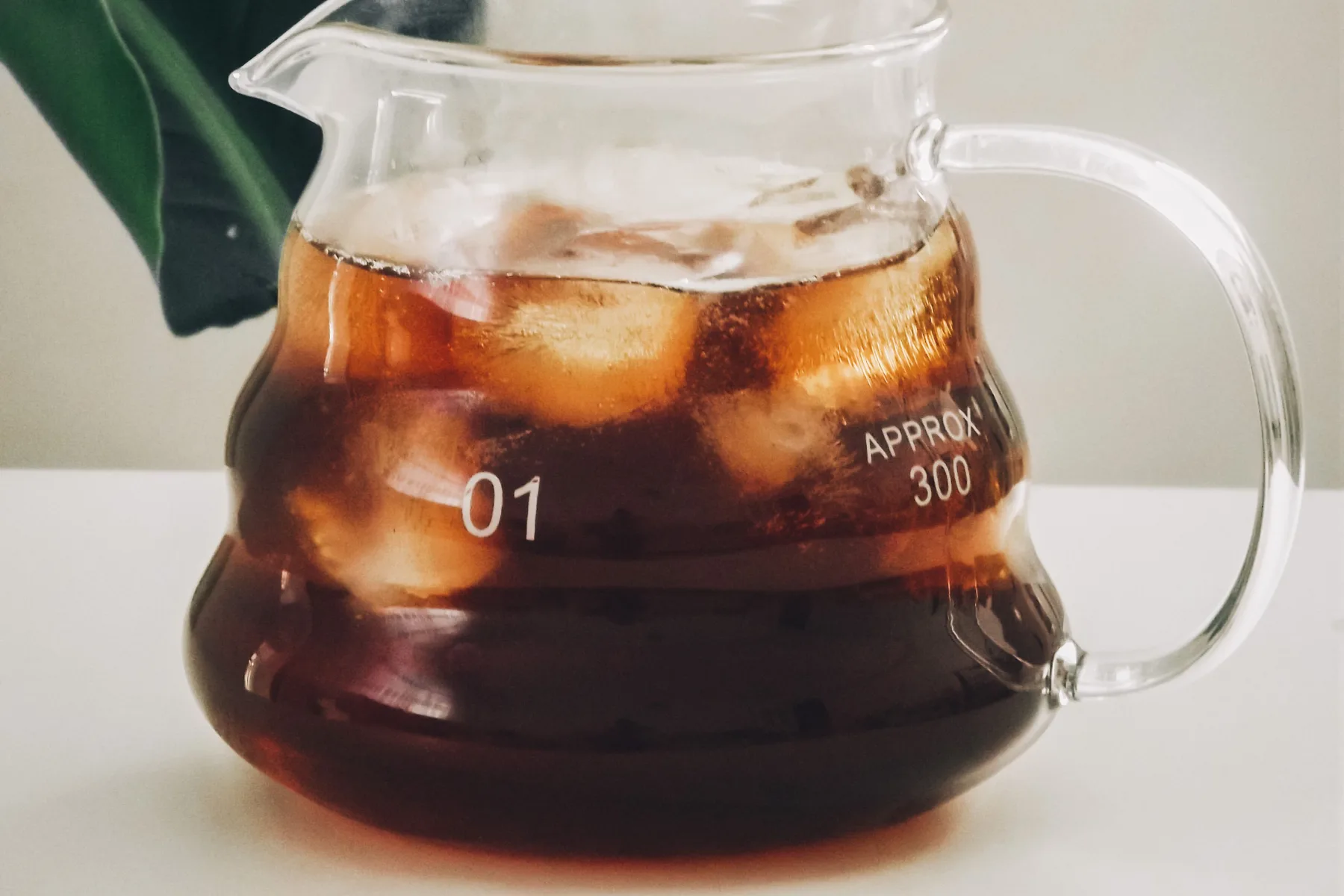
The card below has the full recipe. Start with clean hands and equipment, because cold brew is never heated.
Cold brew is coffee made without hot water. You steep ground coffee in cool or room-temperature water for many hours, then separate the grounds from the liquid. There is no heating step at all.
That makes it one of the least hands-on ways to make coffee, but recipes disagree on the ratio, the grind and especially the time. This guide gives you one clear place to start, built on a published study that tested cold brew recipes with trained tasters.
What you need
- 60 g of coffee, ground coarse, or whole beans and a grinder
- 700 g of water you would happily drink
- A clean jar or pitcher with a lid
- A fine sieve lined with a paper coffee filter, or a filter bag
- A kitchen scale, if you have one, and space in the fridge
A scale makes the recipe repeatable, because you can keep the coffee and water the same from one batch to the next.
| Coffee | 60 g |
|---|---|
| Water | 700 g, cool or room temperature |
| Ratio | about 1:11.7 |
| Grind | coarse starting range |
| Steep | about 14 hours, covered, at room temperature |
| Finish | strain, refrigerate, taste before adding water, milk or ice |
| Hygiene | clean hands, clean jar and strainer |
A starting point built on one published tasting study, not the one right recipe. Change one thing at a time.
Step 1: Start clean
Wash your hands, and make sure the jar, lid and strainer are clean before you start.
This matters more for cold brew than for hot coffee. The Canadian Food Inspection Agency describes cold brew as higher risk than traditionally brewed coffee. It is never heated, and it may be kept in the fridge for a long time, which gives any contaminants a chance to survive or grow. A University of Georgia report on its food-safety research says contamination happens during brewing, through contaminated ingredients, unclean equipment or unwashed hands.
Step 2: Weigh 60 g of coffee, ground coarse
Our grind size chart starts cold brew at coarse, and coarse is the grind that scored best with the tasters in the study behind this baseline. Coarse is still a range, not one grinder number, because grinder scales differ between brands.
Step 3: Add 700 g of water and stir
Put the coffee in the jar, add 700 g of cool or room-temperature water, and stir gently so all the grounds are wet. Then put the lid on. If you use a filter bag, you can put the coffee in the bag first and set it in the water, as the study did.
That is a ratio of about 1:11.7 (700 ÷ 60). To make more or less, keep the same ratio; the coffee-to-water ratio guide shows how to scale it.
Step 4: Steep for about 14 hours at room temperature
Leave the covered jar at room temperature for about 14 hours. The numbers come from a 2019 study in Scientific Reports by Cordoba and colleagues. They brewed 60 g of coffee per 700 g of water at room temperature (20°C), at two grind sizes and for 14 or 22 hours. Their three trained tasters gave the highest scores to the coarse grind and the shorter 14-hour steep, for both coffees tested. That is one small study, so treat 14 hours as a starting point, not proof that it suits every coffee.
Step 5: Strain
Pour the coffee through a fine sieve lined with a paper filter, or lift out the filter bag. Go slowly at the end so the sediment stays behind.
Step 6: Refrigerate, then taste
Put the strained coffee in a clean, covered container in the fridge. Taste a little on its own before you change anything; the study does not describe adding water before tasting. Then decide whether you want it over ice, with milk or with a splash of water.
Ready to drink or concentrate?
This recipe, 60 g of coffee to 700 g of water (about 1:11.7), is ready to drink. Pour it over ice or add milk without diluting it first, then adjust to taste.
A concentrate uses much more coffee and is meant to be diluted. The National Coffee Association’s cold brew ratio is 1:4 to 1:5, which is concentrate strength; it notes that a concentrate is designed to be diluted with water or enjoyed with ice. Toddy’s recipe uses 340 g of coffee to 1.65 L of water, about 1:4.9. If you make a concentrate, this table shows roughly what each dilution gives:
| Concentrate : water or milk | Roughly like |
|---|---|
| 1 : 1 | about 1:10 |
| 1 : 2 | about 1:15 |
| 1 : 3 | about 1:20 |
1:1 is stronger than this guide’s recipe, 1:2 is close to hot filter coffee, and 1:3 is Toddy’s suggested starting point. The table assumes a 1:5 concentrate that extracts about as much as a regular brew, so treat it as a rough guide. Start in the middle and adjust.
How long does homemade cold brew keep?
Keep it in the fridge. Our house default: finish it within about 7 days. That is a cautious default, not a tested safety limit, because no food-safety source we found gives a safe number of days for home cold brew. Toddy, which makes a cold brew system, says its concentrate “will stay fresh for up to 2 weeks” in the fridge; that is a freshness claim, not a food-safety test.
University of Georgia researchers who added harmful bacteria to cold brew found that the bacteria did not grow, but they did not die off quickly either. Three of the four types survived about 9 to 12 days, and one (Bacillus cereus) survived more than 30 days. Even fresh cold brew can make you sick if enough bacteria got in while it was brewed, so keeping it cold does not make contaminated cold brew safe. The report advises keeping cold brew refrigerated for only a limited time, without giving a number of days, which is why our default is shorter than a maker’s two weeks. The simplest habit is to make a batch small enough to finish within a week, and to pour it out if it smells off or you are unsure how it was kept.
Where sources disagreeHow long cold brew keeps
The question
How many days does homemade cold brew keep in the fridge?
CMC verdict
No source gives a safe number of days that fits every kitchen. Brew with clean equipment, refrigerate it promptly in a covered container, and make an amount you will finish soon (this guide's default is a week). Pour it out if you are unsure how it was handled or kept cold. Once milk is in, follow the milk's storage needs and drink it promptly.
Try it yourself
You can note how the aroma and taste change over the days, but tasting is not a safety test. Never taste a batch you think was contaminated or left warm too long.
See the sources
Source A
Toddy (a cold brew maker)
Its printed brewing guide says its concentrate "will stay fresh for up to 2 weeks" in the fridge. That is a freshness claim.
Source B
Food-safety researchers
University of Georgia researchers found that harmful bacteria did not grow in cold brew but survived for days to weeks, and the report gives no storage limit in days. A Canadian Food Inspection Agency survey of 59 retail cold brews found none of the pathogens it tested for, flagged 15 for high general bacteria counts, a sign of poor sanitation, and says its sample was limited.
Why they differ
How long it tastes good and how long it is safe are different questions. A clean commercial process, a home jar, concentrate, diluted coffee, added milk, your fridge's temperature and how the coffee is handled do not all carry the same risk. Coffee can lose its aroma before it is unsafe, and the fridge does not make contaminated coffee safe.
Fix cold brew that tastes off
Grind, ratio, steep time, steeping temperature, straining and dilution all shape the cup. Change one of them per batch, so you can tell what helped.
- Weak: first check that you did not dilute it more than you meant to. Then use a little more coffee for the same water, or steep a little longer. In the Cordoba study, 22 hours extracted more than 14, but the tasters preferred 14.
- Too strong: add a little cold water or milk, or pour it over ice. If it is always too strong, use a little less coffee next time.
- Harsh, flat or stale: go back to about 14 hours if you have been steeping longer, strain it promptly and keep it cold. See why coffee tastes bitter for other causes, and the extraction guide for why time and grind matter.
Frequently asked questions
How long should cold brew steep?
This guide uses about 14 hours at room temperature. Researchers describe typical steeps of 8 to 24 hours. In one study, tasters preferred 14 hours to 22, and in another, caffeine and one acid stopped rising after 6 to 7 hours.
Is cold brew less acidic than hot coffee?
It depends on the measure. In a 2018 study of light-roast coffees, cold and hot brews had a similar pH, but the hot brews had more total titratable acid. The study did not test effects on your stomach, and this guide makes no health claim.
Can I steep cold brew in the fridge?
Yes. In a 2024 lab study, a 4-hour steep in the fridge and one at room temperature tasted mostly alike. Neither showed growth in the general bacteria counts the researchers measured over six weeks of cold storage. But the study did not test for harmful bacteria, so it does not show how long homemade cold brew stays safe to drink. The tasting study behind this guide steeped at room temperature, so this guide does too.
Does cold brew need a coarse grind?
Coarse is the usual starting point and the one this guide uses, but it is not a rule. In one study, medium and coarse grinds gave similar caffeine levels, though grind size was not tightly controlled. Start coarse, then change the grind one step at a time if you want a different cup.
- Start clean. Cold brew is never heated, so clean hands, jar and strainer matter more than with hot coffee.
- Strain it, keep it in the fridge and finish it within about 7 days: our cautious house default, not a tested safety limit.
- Longer is not automatically better: tasters in one study preferred 14 hours to 22.
- Taste it on its own first, then decide on water, milk or ice. Change one thing per batch.
Sources
- Cordoba et al., Effect of grinding, extraction time and type of coffee on the physicochemical and flavour characteristics of cold brew coffee, Scientific Reports (2019).
- Fuller and Rao, The effect of time, roasting temperature, and grind size on caffeine and chlorogenic acid concentrations in cold brew coffee, Scientific Reports (2017).
- Rao and Fuller, Acidity and antioxidant activity of cold brew coffee, Scientific Reports (2018).
- Lopane et al., An investigation of the shelf life of cold brew coffee and the influence of extraction temperature using chemical, microbial, and sensory analysis, Food Science & Nutrition (2024).
- National Coffee Association, Cold brew coffee (concentrate ratio, 1:4 to 1:5).
- Toddy, Cold Brew System brewing guide (2020): concentrate recipe, “up to 2 weeks in your refrigerator”, and a 1:3 starting dilution.
- Canadian Food Inspection Agency, Bacterial pathogens in cold brewed coffee, April 1, 2018 to March 31, 2019.
- University of Georgia College of Agricultural and Environmental Sciences, Can cold brew coffee make you sick? (2024).
Published Updated
See sourcesReport a correction — fixes are logged in the Updated date.