
Article
Burr vs Blade Grinders Explained
Edited and reviewed by Coffee Made Clear TeamUpdated 6 min read
A blade grinder chops beans with a spinning blade, so you get a mix of big pieces and fine dust.
A burr grinder crushes beans between two burrs. The gap between them sets the size, so the grounds come out more even.
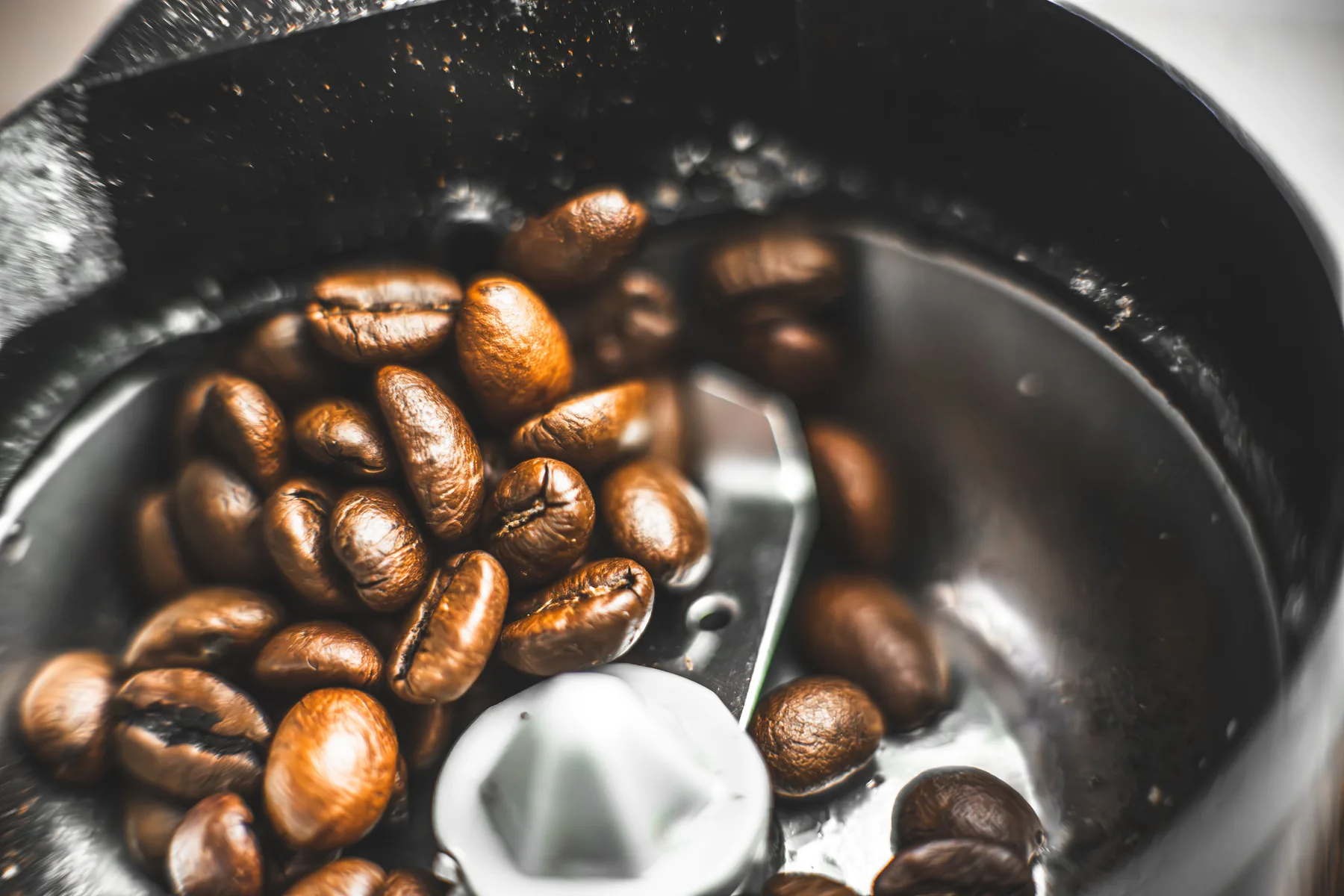
Even grounds make it easier to control a brew and to repeat a cup you liked. If you own a blade grinder, you can still help it: fill it above the blades, shake it only if your manual allows it (with the lid held closed), and stop when the grounds look right for your method.
Both kinds of grinder turn whole beans into grounds. They do it in very different ways, and that changes how even the grounds are. This guide explains the difference, why it matters in the cup, and how to get the best from the grinder you have. Deciding whether to grind at home at all? Try the Grind at Home Decision Test.
How a blade grinder works
A blade grinder has a metal blade that spins in a small bowl, a bit like a tiny blender. It chops the beans for as long as you run it. There is no size setting. The longer it runs, the finer the grounds get.
Because the blade hits beans at random, it breaks them unevenly. You end up with large pieces and fine dust in the same batch. In a 2020 lab test that measured grounds with laser light, a blade grinder gave by far the widest mix of sizes of any grinder in the test.
How a burr grinder works
A burr grinder crushes beans between two precisely cut grinding surfaces called burrs. One burr stays still and the other turns. You set the distance between them, and that gap decides how coarse the grounds are.
A burr grinder is not perfect. Beans break apart on impact, so it also makes some very fine pieces and some larger ones. But most of the grounds land closer to one size than they do with a blade.
- 1. Blade grinder: a blade spins and chops the beans for as long as you run it.
- 2. The result is a mix of large pieces and fine dust.
- 3. Burr grinder: beans are crushed between two burrs, one fixed and one turning.
- 4. The gap between the burrs sets how coarse the grounds are.
Why an even grind matters
Small pieces give up their flavor faster than big ones. Grinding research describes this directly: the smaller particles extract more quickly.
So a mixed grind brews unevenly. The fine dust can give up a lot while the big pieces give up little. A test kitchen that rated grinders put it simply: too many fines makes coffee bitter, and too many big pieces makes it weak.
The same test kitchen also found little to no difference between drip coffee made with a high-quality blade grinder and with a burr grinder. So the burr grinder’s main advantage is control: you can set a size and get it again.
The closer the grounds are to one size, the easier it is to control how water flows through them. That makes a recipe easier to repeat from day to day.
| Feature | Blade grinder | Burr grinder |
|---|---|---|
| How it grinds | A spinning blade chops the beans, like a tiny blender | Two burrs crush the beans; one stays still and the other turns |
| Size setting | None: the longer it runs, the finer the grounds | You set the gap between the burrs |
| Spread of sizes | Large pieces and fine dust together; the widest mix of any grinder in a 2020 lab test | Most grounds land closer to one size, with some very fine and some larger pieces |
| Repeating a grind | Run it the same way each time | Set a size and get it again |
- 1. Fines: very small pieces that give up their flavor fast.
- 2. Boulders: big pieces that give up their flavor slowly.
- 3. A burr grind gathers most pieces near one size.
- 4. Even good burr grinders make some fines.
What you need
- Your grinder, burr or blade.
- Whole beans and your usual recipe. A kitchen scale makes the recipe easier to repeat.
- The grind size chart, to see roughly what size your brewing method needs.
- Your grinder’s manual, for its settings and running-time limit.
A more even grind
- Blade grinder fill
- above the blades, not to the top
- Shaking
- only if your manual allows it, lid held closed
- Running time
- within your manual's limit
- Stop
- when the size looks right for your method
- Burr grinder
- change one step at a time
Compare the grounds with the grind size chart for your method.
Step 1: With a blade grinder, grind only what you need
One blade-grinder manual says to grind only the amount needed for each use.
Step 2: Fill the bowl above the blades, but not to the top
A test kitchen recommends filling to above the blades or the bowl’s minimum fill line. NESCO’s manual says to leave about 12 mm (1/2 in) of space so the beans can move.
Step 3: Shake only if your manual allows it
If your grinder’s manual allows shaking, hold the lid closed and shake it a little so pieces keep falling back onto the blades. If the manual does not say, leave the grinder on the counter and let it run.
Safety. The blade is sharp and spins fast. Keep your fingers and anything else away from the blade. Unplug the grinder before you open it, empty it or clean it, and wait for the blade to stop first. Follow your grinder’s manual.
Step 4: Stay within the running limit
NESCO’s manual allows up to 20 seconds at a time. Check yours.
Step 5: Stop when the size looks right
Compare the grounds with the grind size chart for your method.
Step 6: Repeat the same way
Use the same amount of beans and the same grinding time each day, so changes in the cup mean something.
With a burr grinder
- Start at a sensible setting. Use your manual or the grind size chart as a starting point.
- Change one step at a time. Brew, taste, and only then move the setting again.
- Keep the burrs clean. Baratza says regular cleaning helps the burrs give the most consistent grind. See how to clean a coffee grinder.
Troubleshooting
My blade grinder leaves whole beans behind
The beans are probably sitting out of reach of the blade. Add enough beans to cover the blades, and shake the grinder only if your manual allows it, with the lid held closed.
My coffee tastes bitter and harsh
With a blade grinder, try a slightly shorter grinding time so you make less dust. With a burr grinder, a harsh cup that also drained very slowly points to testing one step coarser. Bitter cups have other causes too, so change one thing at a time.
My coffee tastes weak or sour
With a blade grinder, try grinding a little longer so fewer big pieces remain. With a burr grinder, a sour cup that also brewed fast points to testing one step finer. If the cup is simply weak, check your coffee-to-water ratio first with the ratio calculator.
Grounds cling to the grinder and spill
That is usually static. Small grounds stick to surfaces in and on the grinder and the grounds bin. See grinder retention and grind consistency for a simple way to reduce it.
Frequently asked questions
Is a burr grinder really better than a blade grinder?
For control and repeatability, yes. A burr grinder sets the size with the gap between its burrs, and in one lab test a blade grinder gave by far the widest mix of particle sizes. The taste gap can be small: a test kitchen found little to no difference in drip coffee made with a high-quality blade grinder and a burr grinder.
Can I use a blade grinder for pour-over or French press?
Yes. Fill it above the blades, shake it only if your manual allows it (with the lid held closed), and stop when the grounds match the size your method needs. Expect more fine dust and big pieces than a burr grinder gives, so taste the cup and adjust the grinding time.
How long should I run a blade grinder for coffee?
There is no one right time. The longer it runs, the finer the grounds get. NESCO's manual says to run its grinder for no more than 20 seconds at a time and to experiment with the grinding time. Check your own manual for its limit.
Do burr grinders make fine dust too?
Yes. Beans break apart on impact, so even a burr grinder makes some very fine pieces, called fines. A good burr grinder still keeps most pieces closer to one size than a blade does.
- A blade grinder chops beans into a mix of big pieces and fine dust. A burr grinder crushes them between two burrs, so the grounds come out more even.
- Small pieces give up their flavor faster than big ones, so a mixed grind brews unevenly.
- A burr grinder's main advantage is control: you can set a size and get it again.
- With a blade grinder, fill above the blades, shake only if your manual allows it, and stop when the grounds look right.
Sources
Studies and pages used for the claims above.
- National Coffee Association, Drip coffee, About Coffee.
- Mahlkönig, Blade grinders vs. burrs: a comparison (2022). A grinder maker’s explanation of how each type works.
- Howard Bryman, Equipment Report: Four Mid-Range Burr Coffee Grinders Tested & Reviewed, Coffee Review (2020). Includes a laser-diffraction test of blade-ground samples.
- Uman et al., The effect of bean origin and temperature on grinding roasted coffee, Scientific Reports (2016).
- America’s Test Kitchen, The Best Blade Grinders (2026). Used for grinding technique only, not for product choices.
- Baratza, Encore Owner’s Manual (revision 5/2014), care and cleaning section. Used for its note on cleaning and grind consistency.
- NESCO, Blade Coffee Grinder BG-13 use and care guide. Used as one example of a blade grinder’s running limit and care steps.
Published Updated
See sourcesReport a correction — fixes are logged in the Updated date.