
Article
The Coffee Bloom, Explained
Edited and reviewed by Coffee Made Clear TeamUpdated 4 min read
The bloom is a small first pour that wets all the grounds before the main pours.
Our pour-over recipe uses about twice the coffee's weight in water and waits 30–45 seconds while fresh coffee bubbles.
No study we found compared the taste of bloomed and unbloomed coffee.
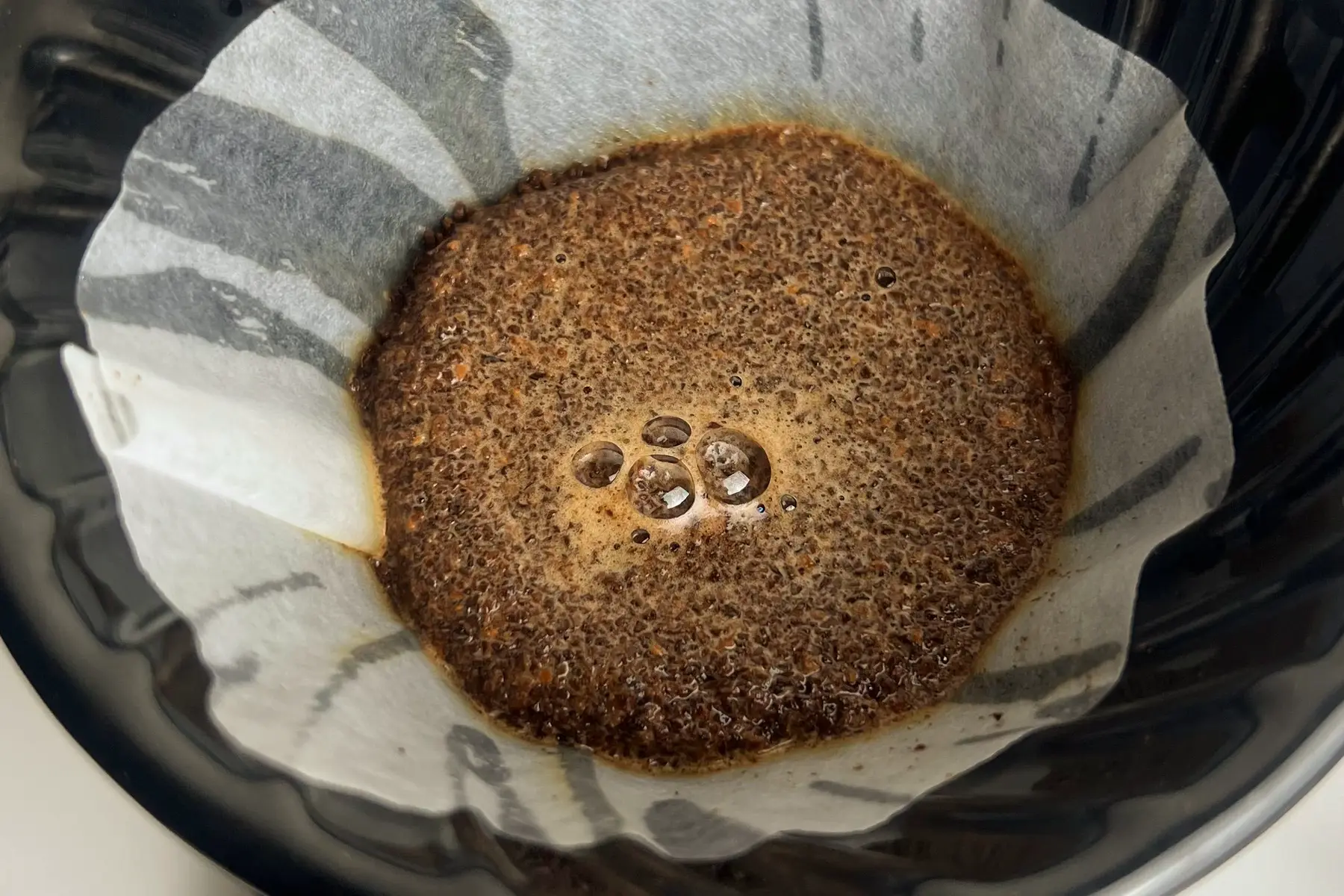
Keep the bloom because it is quick and the recipes we cite use it, not because it has been proven.
When water first lands on fresh ground coffee, the bed puffs up and bubbles. Pour-over recipes call this the bloom, and the recipes we cite pause for it before the main pours. This guide explains what is happening, what studies have measured, and what they have not.
What the bloom is
The bloom is a small first pour, just enough to wet all the grounds, followed by a short wait. In our pour-over recipe, that is about 40 g of water on 20 g of coffee, then 30–45 seconds before the next pour.
The National Coffee Association says letting the gas out first helps the later pours wet the bed more evenly. Recipes differ on the amount. The Alpha dripper recipe on Hario USA blooms with 2–3 times the coffee’s weight in water, and Camber’s V60 recipe on Hario USA blooms with 60 g.
In our dataset of published recipes, 37 recipes state a bloom. The median bloom uses twice the coffee’s weight in water and waits 30 seconds; 27 of the 37 use 2–3 times the dose, and 32 wait 30 to 45 seconds.
Why fresh coffee bubbles
Roasting makes gases, and much of that gas is carbon dioxide. Some escape during roasting, and the rest stay trapped in the bean’s porous structure. A study from the Zurich University of Applied Sciences describes how that gas leaks out slowly while coffee is stored, and more abruptly when it is ground and brewed. The bubbles in the bloom are that gas leaving.
Ground coffee also swells when it gets wet. A Technical University of Munich study measured how much, and how fast.
What the studies measured
| Study | What was tested | Sample | Finding |
|---|---|---|---|
| Smrke et al. (2018), Journal of Agricultural and Food Chemistry | Gas released by whole beans and ground coffee, measured as weight lost over time | Whole Arabica beans, and ground Arabica and Robusta, at several roast degrees and roast speeds | Coffee keeps part of its carbon dioxide after roasting and releases it during storage, grinding and extraction. The authors say carbon dioxide may affect the cup, but the study did not test taste. |
| Hargarten, Kuhn and Briesen (2020), Journal of the Science of Food and Agriculture | How ground coffee particles swell in water, measured by laser diffraction and microscopy | Grounds of several sizes and roast degrees, at two water temperatures | Particles grew by about 15%. They reached 60–80% of that within 30 seconds, and finished after about 4 minutes. Wetting also broke off some fines, more so in hotter water. |
What is missing is a taste test. We found no published study that brewed the same coffee with and without a bloom and compared the cups (PubMed searches, October 2026).
CMC verdict: keep the bloom in pour-over. It costs 30–45 seconds, the recipes we cite use it, and the studies show why the grounds bubble and swell at the start. Treat it as a sensible habit, not a proven flavor fix. If you want to know whether it matters for your coffee, brew twice with the same recipe and change only the bloom.
What you need
- Your pour-over dripper, a filter and freshly ground coffee
- A kettle, a kitchen scale and a timer
How to bloom
Step 1: Weigh the coffee and the bloom water
Weigh your coffee, then double it for the bloom water. For 20 g of coffee, that is about 40 g of water, as in our pour-over recipe.
Step 2: Pour just enough to wet all the grounds
Start the timer and pour the bloom water gently over the whole bed, so no dry grounds are left.
Step 3: Wait 30–45 seconds
Let the coffee bubble and settle. Keep the wait the same from brew to brew.
Step 4: Carry on with the main pours
Pour the rest of the water as your recipe says. If the cup needs work, change the grind or the ratio first, not the bloom. The coffee extraction guide explains why.
Troubleshooting
- Dry patches after the bloom: pour a little more water over them next time, enough to wet every ground.
- The bloom rises fast and unevenly: the beans may be very fresh. See the next section.
- Hardly any bubbles: the beans may have lost much of their gas in storage. Taste the cup before you change anything.
Reading your bloom
Methodical Coffee, a roaster, says a very lively, uneven bloom can mean the beans are very fresh. Our guide to resting coffee beans covers how long to wait after the roast date. A quiet bloom fits the other end: the gas leaves slowly in storage, so older beans release less of it. Neither tells you how the cup will taste, so taste before you change anything.
Frequently asked questions
How long should a coffee bloom last?
The National Coffee Association says about 30–45 seconds, until the bubbling stops. Our pour-over recipe does too. Doing it the same way every time matters more than the exact second.
Why does my coffee not bloom?
Roasted coffee keeps carbon dioxide inside the beans and loses it slowly in storage, so older beans release less gas when water hits them. A flat bloom on its own does not mean the cup will taste bad.
Do I need to bloom French press or drip coffee?
Our French press recipe has a similar first stage: about 65 g of water, a gentle stir, and about 30 seconds before the rest. Our drip guide has no bloom, because the machine controls the water.
- Bloom with about twice the coffee's weight in water, then wait 30–45 seconds.
- The bubbles are carbon dioxide from roasting, released as water reaches the grounds.
- Wet grounds swell fast: most of the swelling happens in the first 30 seconds.
- No study we found tested whether the bloom changes the taste.
- A very lively, uneven bloom can mean the beans are very fresh, one roaster says.
Sources
- Smrke, Wellinger, Suzuki, Balsiger, Opitz and Yeretzian, Time-Resolved Gravimetric Method To Assess Degassing of Roasted Coffee, Journal of Agricultural and Food Chemistry (2018).
- Hargarten, Kuhn and Briesen, Swelling properties of roasted coffee particles, Journal of the Science of Food and Agriculture (2020).
- Methodical Coffee, Freshly Roasted Coffee, Explained: Degassing, Rest, and Flavor.
- National Coffee Association, Pour-over coffee.
- Hario USA, Hario Alpha Dripper (recipe courtesy of Eight Ounce Coffee) and V60 recipe with Camber Coffee.
Published Updated
See sourcesReport a correction — fixes are logged in the Updated date.