
Article
French Press vs Pour-Over: How to Choose
Edited and reviewed by Coffee Made Clear TeamUpdated 8 min read
Choose a French press if you value body, a forgiving pour and easy batch scaling.
Choose pour-over if you value a cleaner cup, more control over the pour and a hands-on routine. Neither is better in general; the five Method Match questions below help you pick.
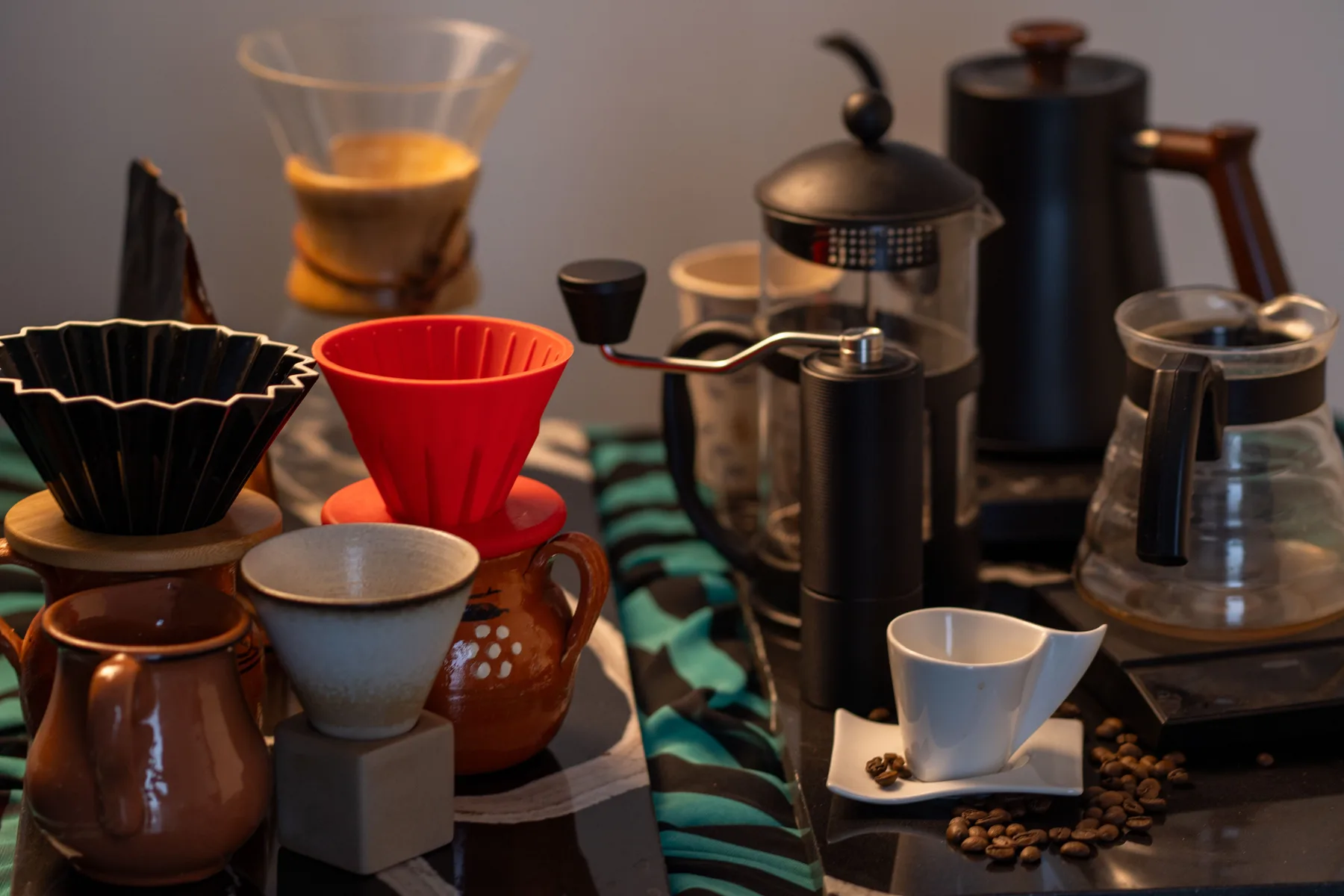
They differ in how the water meets the coffee (steeping versus flowing through) and in the filter (metal mesh versus paper), so compare each at its own recipe, not one shared grind.
If you are choosing between a French press and a pour-over, the useful answer is not “one is better.” Both make coffee with hot water, but in mechanically different ways. A French press is a full-immersion brew, separated at the end with a metal mesh. A pour-over sends water through a bed of coffee, usually through paper.
In this guide we explain what those differences change in the cup and in your routine, then give the Method Match test: five questions and a tie-breaker to choose between the two. If you are open to other brewers too, the five-method version at the end covers AeroPress, moka pot and drip as well.
Immersion versus flow-through
In a French press the grounds sit in all the water for most of the brew, and a plunger with a metal mesh separates them at the end. In a V60-style pour-over, fresh water is poured from above and passes through the coffee bed and a paper filter into the cup or server below.
That difference matters. Research on packed coffee beds shows that uneven pouring, dry pockets and the bed’s shape can make some parts of the bed extract more than others, and the researchers modelled a cone like a pour-over dripper. That does not make pour-over inconsistent; it means the pour is a real brewing variable.
Immersion behaves differently. In a controlled full-immersion study, changing the ratio of coffee to water strongly changed the strength of the brew, while the share of the coffee extracted changed much less across most of the range tested. That was a lab system, not every French press, but it shows the two methods should not borrow each other’s rules.
The filter changes the cup
Paper and metal let different things through. The National Coffee Association says paper filters absorb more of the coffee’s oils, which can give a cleaner, lighter taste, while metal filters let more oil and sediment into the cup.
The studies below are the evidence behind that, and where it runs out:
| Study | Sample | Taste | Oils | Sediment |
|---|---|---|---|---|
| Santanatoglia et al. (2023), Foods | One medium-roast Kenyan specialty coffee, brewed through paper (V60, AeroPress) and metal (French press, Pure Brew); six brews per method; four certified tasters | Paper-filtered brews had more caramel- and flower-related aroma compounds, metal-filtered brews more fruity and roasted ones. The French press scored lowest on every attribute except acidity, though not every difference was statistically significant. | Not measured | Not measured |
| Rendón, Scholz and Bragagnolo (2017), Food Research International | Two coffees, high and low in cafestol, chosen from 13, brewed through paper | Not measured | Of the coffee’s cafestol, a fatty compound, 0.15% reached the brew; the spent grounds kept 87.45% and the paper 12.41%. | Not measured |
| Orrje et al. (2025), Nutrition, Metabolism and Cardiovascular Diseases | Coffee from 11 workplace brewing machines and 3 liquid-model machines, 5 home paper-filtered coffees, plus other brews | Not measured | Home paper-filtered coffee had a median of 12 mg/L of cafestol, as the abstract reports; French press and percolator coffee had about 90 mg/L. | Not measured |
| Gagné (2019), Coffee ad Astra (a blog, not peer-reviewed) | About a dozen paper, cloth and metal filters under a microscope, with water-only flow tests; no coffee brewed | Not measured | Not measured | Not weighed. Metal filters have larger pores than paper, so the author reasons that fines small enough to pass them reach the cup. |
What is missing is a sediment study. We found none that weighed or counted the grounds in a French press cup against a paper-filtered one, and the one tasting study used a single coffee and one recipe per brewer (searches, October 2026).
CMC verdict: the oil difference is the best supported: paper-filtered coffee carries very little cafestol (0.15% in one study, most of it staying in the grounds), and French press coffee carries several times more. That is a difference in composition, not medical advice; ask a doctor if it matters for your health. On taste and sediment the evidence is thin, so choose by the texture you like: paper for a cleaner, lighter cup, metal for more body and some fine sediment.
The Method Match test
Answer five questions. The method with more matches is the better starting point for your routine.
| Question | French press match | Pour-over match |
|---|---|---|
| Preferred texture | Full body and some sediment are acceptable | Clean cup and low sediment |
| Attention during brewing | Pour, wait, plunge | Stay present and control several pours |
| Kettle | An ordinary kettle is fine | A gooseneck helps control but is not mandatory |
| Batch | Easy to scale within the press’s capacity | Best when the dripper and filter suit the batch |
| Cleanup | Scoop or rinse grounds from a mesh press | Lift out and discard a paper filter |
If the score ties, let texture decide: paper versus metal filtration makes the most persistent difference in the cup. Method Match is our editorial decision aid, not a scientifically validated scoring system.
A fair comparison
Do not compare the two with one grind and one recipe. Start each at its own baseline, keep the coffee and water as close as practical, and judge the cup each method is designed to make. A French press should not lose for being less clear; that body is part of the method. A pour-over should not lose for needing attention; that control is part of the method.
Our baselines are a good place to start: 1:15 for the French press, ground medium-coarse to coarse, and 1:16 for pour-over, medium-fine. If you want one shared reference for both, the Specialty Coffee Association describes 60 g of coffee per liter of water, about 1:16.7, as a common way to express brewing ratio for both drip and immersion coffee. It is a starting reference, not the correct ratio for either.
Not just these two?
If you are also weighing an AeroPress, a moka pot or a drip coffee maker, the five-question version below compares all five. It runs in this page only and does not save or send your answers.
Which brewing method fits your mornings?
Answer five questions about texture, attention, batch size, cleanup, and equipment. Method Match recommends a place to start and explains the tradeoff. It does not rank one method as universally better.
How Method Match scores your answers
Each answer adds points to one or more methods. The highest total wins. If methods tie, the texture answer decides; if that does not separate them, the batch-size answer decides; if they are still tied, Method Match shows them together and does not pick a winner.
| Answer | Pour-over | French press | AeroPress | Moka pot | Drip coffee maker |
|---|---|---|---|---|---|
| 1. How do you want the cup to feel? | |||||
| Clean and light | +2 | – | +1 | – | – |
| Full and textured | – | +2 | – | +1 | – |
| Concentrated for milk or dilution | – | – | +1 | +2 | – |
| No preference yet | – | – | +1 | – | +1 |
| 2. How much attention do you want to give the brew? | |||||
| I enjoy controlling the pour | +2 | – | – | – | – |
| I want to pour, wait, and finish | – | +2 | +1 | – | – |
| I want the machine to handle the water | – | – | – | – | +2 |
| I will watch the stove for a short brew | – | – | – | +2 | – |
| 3. How much coffee do you usually make? | |||||
| One small cup | +1 | – | +2 | – | – |
| One large mug | +2 | – | +1 | – | – |
| Two to four cups | – | +2 | – | – | +2 |
| More than four cups | – | – | – | – | +3 |
| 4. Which cleanup sounds least annoying? | |||||
| Lift out a paper filter | +2 | – | +1 | – | +2 |
| Rinse a mesh and remove wet grounds | – | +2 | – | – | – |
| Rinse a metal pot after it cools | – | – | – | +2 | – |
| 5. What equipment do you already have? | |||||
| Gooseneck kettle and scale | +2 | – | – | – | – |
| Ordinary kettle | – | +1 | +1 | – | – |
| Stovetop | – | – | – | +1 | – |
| Automatic coffee maker | – | – | – | – | +2 |
| None of these | – | – | – | – | – |
Frequently asked questions
Is French press or pour-over better?
Neither, in general. They make different cups: a French press gives more body and some sediment, a paper pour-over a cleaner, lighter cup. Choose the one whose tradeoffs suit you.
Which is easier for a beginner?
Neither is objectively easier. A French press asks you to pour, wait and plunge; a pour-over asks you to stay and control several pours. If you already own one, start with it.
Do I need a gooseneck kettle for pour-over?
No. The National Coffee Association says a standard kettle works, though a short spout pours faster and is harder to control. A gooseneck helps but is not required.
Does a paper filter change what is in the cup?
Yes. Paper holds back more of the coffee oils. In one study only a tiny share of the coffee’s cafestol reached the brew through paper, and a 2025 study measured much less of it in paper-filtered coffee than in French press coffee.
- A French press steeps the grounds and separates them with a metal mesh; a pour-over sends water through a bed of coffee and usually through paper.
- Paper tends to give a cleaner, lighter cup; metal lets more oil and sediment through.
- Neither method wins for everyone: choose by texture, attention, kettle, batch and cleanup.
- If the questions tie, let texture decide, and compare each method at its own recipe.
Sources
Studies and pages used for the claims above.
- Santanatoglia et al., Discrimination of Filter Coffee Extraction Methods of a Medium Roasted Specialty Coffee Based on Volatile Profiles and Sensorial Traits, Foods (2023).
- Moroney et al., Analysing extraction uniformity from porous coffee beds using mathematical modelling and computational fluid dynamics approaches, PLOS ONE (2019).
- Liang, Chan and Ristenpart, An equilibrium desorption model for the strength and extraction yield of full immersion brewed coffee, Scientific Reports (2021).
- Rendón, Scholz and Bragagnolo, Is cafestol retained on the paper filter in the preparation of filter coffee?, Food Research International (2017).
- Orrje et al., Cafestol and kahweol concentrations in workplace machine coffee compared with conventional brewing methods, Nutrition, Metabolism and Cardiovascular Diseases (2025).
- Jonathan Gagné, An In-Depth Analysis of Coffee Filters, Coffee ad Astra (2019), a blog.
- National Coffee Association, Pour-over coffee and French press coffee.
- Specialty Coffee Association, Water and coffee acidity: how to adapt your water for different extraction methods.
Published Updated
See sourcesReport a correction — fixes are logged in the Updated date.