
Article
How to Choose a Coffee Scale
Edited and reviewed by Coffee Made Clear TeamUpdated 6 min read
Choose a scale with the resolution your brew needs: whole grams for filter, 0.1 g for espresso.
Then check its stated accuracy, a capacity that covers your brewer and water, and a built-in timer.
For espresso, make sure it fits under the cup on the drip tray, and keep it away from standing water.
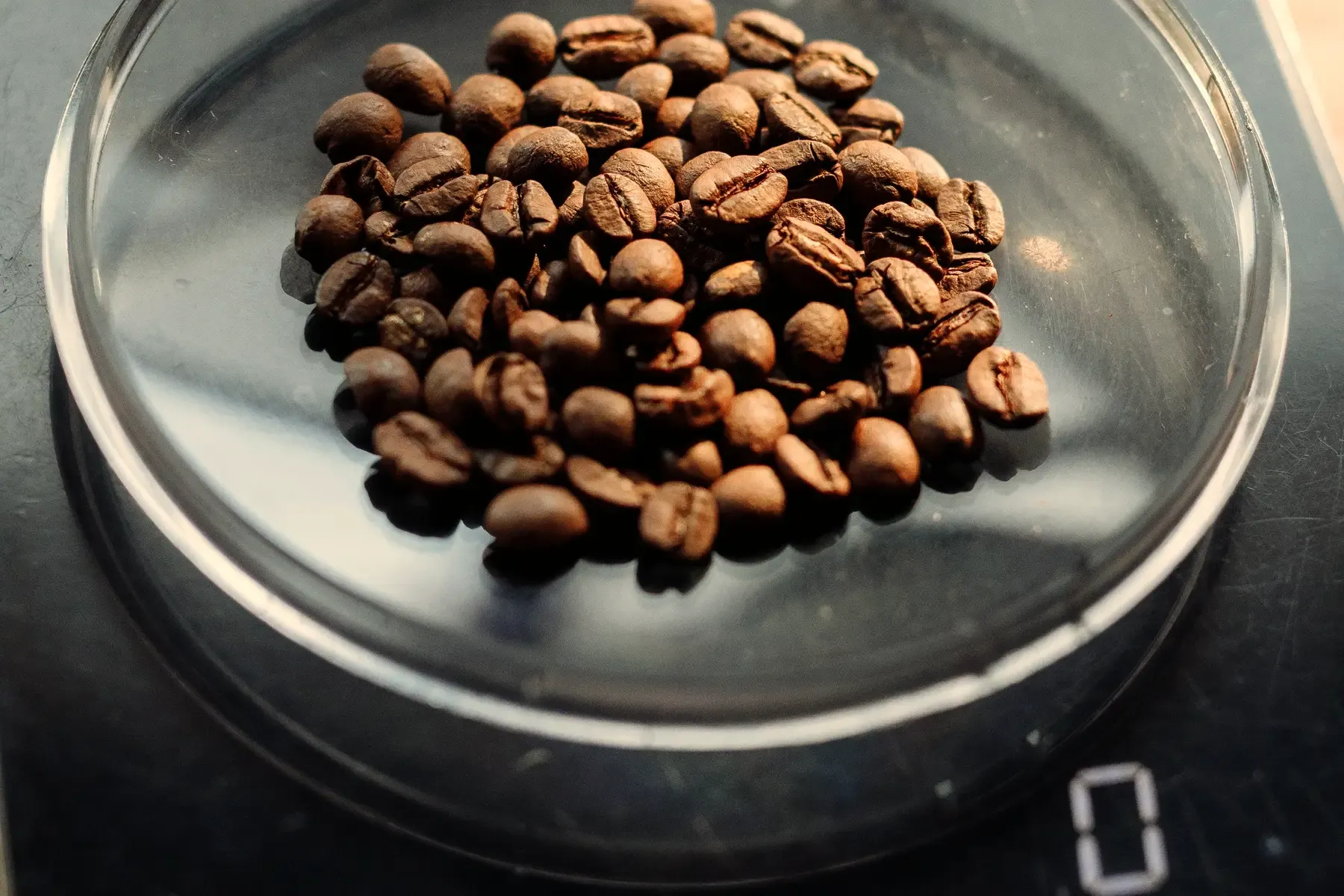
A scale is the cheapest way to make coffee repeatable. Weigh the coffee and the water, and the same recipe tastes the same tomorrow. Scales are simple, but the numbers on the box can mislead: a display that shows 0.1 g tells you less than it seems.
In this guide we set out what to look for in a coffee scale and why, from a trade association, scale makers and roasters. It gives criteria, not product picks.
What to look for
| Look for | Why it matters | What to check |
|---|---|---|
| Resolution for your brew | Whole grams are usually enough for filter coffee; espresso doses and yields are small, so 0.1 g steps matter there. | The smallest step the display shows, and up to what weight it shows it. |
| A stated accuracy | A display that reads to 0.1 g is not necessarily accurate to 0.1 g; the maker’s tolerance tells you how far off a reading can be. | An accuracy or tolerance figure (for example ±0.2 g at low loads), not only the resolution. |
| Capacity for brewer, server and water | The scale weighs everything on it; on some scales the 0.1 g steps also get coarser as the total load rises. | Maximum capacity above your heaviest brewer plus water, and the resolution at that load. |
| A built-in timer | Pour-over and espresso are timed, and a timer on the scale lets you watch weight and time together. | A timer, and whether the display keeps 0.1 g steps while it runs. |
| Quick, steady readings | Scales average their sensor readings: more averaging is steadier but slower, and small drifts from heat and evaporation are normal. | A stated stabilization time or a response setting. |
| A size that fits where you brew | For espresso the scale has to fit under the cup on the drip tray; water-resistant is not waterproof. | The platform size against your drip tray, and the maker’s advice on water. |
| Power and calibration | Readings can drift over time, and a scale is only as accurate as the weight it was calibrated with. | Battery or USB charging, and how the maker says to calibrate it and with what weight. |
Why weigh at all
Scoops measure volume, and coffees differ in size and density. Counter Culture Coffee’s example: one scoop might hold 5 g of one coffee and 8 g of another, so a four-scoop recipe could be 20 g or 32 g, a 60 percent difference. The Specialty Coffee Association and the National Coffee Association give their brewing ratios in grams, and the National Coffee Association says a digital scale helps you brew more consistent espresso. Our coffee to water ratio guide shows how to use the numbers.
Resolution and accuracy
Resolution is the smallest step the display shows. Counter Culture Coffee says a scale that weighs to the nearest gram is usually good enough for brewed coffee, but a scale that reads to a tenth of a gram will be a must for espresso. The Specialty Coffee Association’s cupping standard weighs each cup’s coffee on a scale with 0.1 g accuracy or better.
Accuracy is how close the reading is to the true weight. Acaia says changing the resolution does not change a scale’s accuracy, only how fine the number looks. Makers state accuracy as a tolerance: Hario lists ±0.2 g from 2 g to 200 g on one coffee scale, rising to ±3 g near its 2,000 g limit. Escali lists ±2 g up to 1 kg on a kitchen scale. For an 18 g espresso dose, that difference matters; for 500 g of filter water, it hardly does.
Capacity, timer and response
Capacity covers everything on the platform. Hario’s scale shows an error once the item and container together pass 2,000 g. On some scales the fine steps apply only at low loads: Hario’s shows 0.1 g up to 200 g, then 0.5 g, then 1 g. Check the resolution at the weight you brew, brewer and server included.
A timer helps because pour-over and espresso are both timed. Some scales start the timer when liquid begins to flow, and some tare themselves when a cup goes on. Acaia notes that one older model showed only whole grams while its timer ran, so check the display in timer mode.
Response is a trade-off. Acaia explains that scales average their sensor readings: more averaging gives a steadier number but a slower one. Hario lists about 3 seconds to stabilize. Escali notes that a scale showing 0.1 g steps will always look less steady than one showing whole grams.
Size, water and power
For espresso, the scale has to fit on the drip tray under the cup; one espresso-focused scale measures 105 mm square. Water is the main risk. Acaia says none of its scales are waterproof, and Fellow advises against using its scale in the drip tray because of an exposed charging port. Hario’s manual says never to immerse its scale.
Battery scales can run for months: Hario says about 12 months on two AAA batteries at three uses a day. Rechargeable scales quote hours per charge. Readings can drift over time, so makers suggest calibrating with a reference weight: Acaia every month at home, Fellow periodically with a certified 50 g weight.
Common traps
- “0.1 g on the display means accurate to 0.1 g.” Resolution is not accuracy; read the stated tolerance.
- “It reads 0.1 g all the way up.” On some scales the steps get coarser as the load rises, and the load includes your brewer.
- “If the number drifts, the scale is broken.” Evaporation, heat and the sensor settling under load all move the reading a little; a hot item can shift Hario’s scale by about 2 g at first.
- “Water-resistant means it can sit in the drip tray.” Some makers say their scales are not waterproof.
- “Store things on it.” Some makers say a load on the platform strains the sensor even when the scale is off, so don’t stack scales or leave items on them.
Frequently asked questions
Do I need a scale that reads to 0.1 g?
For espresso, yes. Doses and yields are small: Stumptown uses about 19.5 g of coffee in and 24 to 28 g of espresso out, and Counter Culture Coffee says a scale to the tenth of a gram will be a must. For filter coffee, Counter Culture says a scale that weighs to the nearest gram is usually good enough.
Can I just use my kitchen scale?
Often yes, for filter coffee. Check its stated tolerance: one kitchen scale maker lists ±2 g from 2 g to 1 kg. That is small next to 500 g of water but large next to an 18 g espresso dose. Check the capacity covers your brewer and water too.
Why weigh coffee instead of using scoops?
Coffees differ in size and density. Counter Culture Coffee’s example: a scoop of one coffee might weigh 5 g and a scoop of another 8 g, a 60 percent difference. The Specialty Coffee Association and the National Coffee Association give brewing ratios in grams.
How often should I calibrate it, and with what?
Acaia suggests every month for home use, and after moving the scale somewhere new, with class F1 or F2 weights. Fellow suggests calibrating periodically with a certified 50 g weight. A calibration is only as good as the weight you use.
Why does the reading creep down while I brew?
Water evaporates, and heat from the brew affects the scale’s sensor. Acaia says its sensitive scales detect that evaporation, and suggests a heat pad for long brews. Escali describes a slow settling of the sensor under load, called mechanical creep.
- For filter coffee, a scale that reads to the nearest gram is usually enough; for espresso, 0.1 g steps are a must, Counter Culture Coffee says.
- Resolution is not accuracy. A display that shows 0.1 g can still be off by more; look for a stated tolerance.
- Capacity counts everything on the scale: brewer, server and water. On some scales the 0.1 g steps get coarser as the load rises.
- A timer on the scale lets you watch weight and time together; for espresso, check the scale fits under the cup on the drip tray.
- Small drifts from heat and evaporation are normal. Calibrate now and then with a proper weight, as the maker’s manual says.
Sources
Pages used for the claims above.
- Specialty Coffee Association, SCA Standard 102-2024 Coffee Value Assessment: Sample Preparation and Tasting Mechanics: cupping scale and brew ratio.
- National Coffee Association, Pour-over coffee: weighing in grams.
- National Coffee Association, Espresso: a digital scale for espresso.
- Counter Culture Coffee, Coffee Basics: Brewing Ratios: resolution for filter and espresso.
- Counter Culture Coffee, Coffee Basics: Brewing Better Coffee At Home: scoops.
- Stumptown Coffee Roasters, Brew Guide: Espresso: dose and yield.
- Hario, instruction manual for its coffee scale: resolution, accuracy, capacity, stabilizing time, timer and batteries.
- Acaia, weighing resolution.
- Acaia, recommendations for cafés: response settings and heat.
- Acaia, why the weight decreases during brewing.
- Acaia, whether its scales are waterproof.
- Acaia, what calibration is and why it matters.
- Acaia, scale storage.
- Fellow, its scale and espresso.
- Fellow, calibrating its scale.
- Escali, troubleshooting FAQ for a kitchen scale: kitchen scale tolerance, stability and creep.
Published Updated
See sourcesReport a correction — fixes are logged in the Updated date.