
Article
Espresso Basics: Dose, Yield and Time
Edited and reviewed by Coffee Made Clear TeamUpdated 5 min read
An espresso recipe has three numbers.
The dose is the ground coffee in the basket, the yield is the espresso that ends up in the cup, and the time is how long the shot runs.
Methodical Coffee defines dose as "the amount of coffee used" and yield as "the total output of liquid".
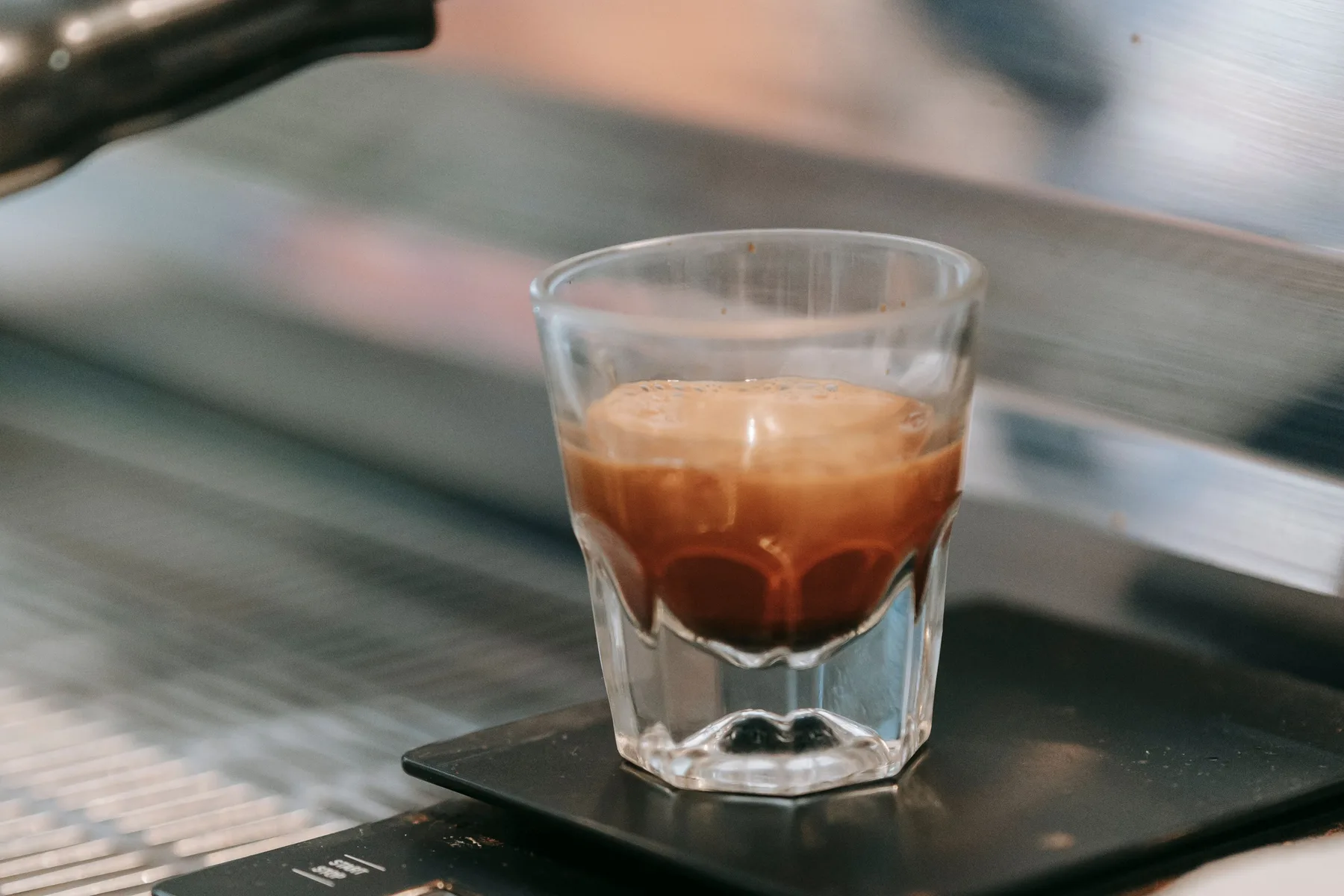
A common starting point is 18 g of coffee in and 36 g of espresso out, a 1:2 ratio, in about 25–30 seconds. All four recipes in this guide use 1:2, and so did the average barista in a 2017 survey reported by the Specialty Coffee Association. Our targets table compares five sources, and our baseline follows it. Weigh both numbers with a scale, then adjust the grind to bring the time into range.
Espresso is coffee brewed fast and strong. The National Coffee Association describes it as high pressure forcing nearly boiling water through finely ground coffee in about 20–30 seconds.
In this guide we explain the three numbers behind every shot, compare four published recipes and five sources’ targets, beside our own baseline, and give a starting point. When the shot does not taste right, our guide to dialing in espresso shows what to change.
Dose, yield and time
- Dose is the dry, ground coffee in the basket. Methodical Coffee defines it as “the amount of coffee used”. La Marzocco Home says the dose should match the size of your basket.
- Yield is the espresso in the cup, weighed. Methodical Coffee calls it “the total output of liquid”.
- Time is how long the shot runs. La Marzocco Home starts the timer the moment water touches the coffee, not at the first drop.
The ratio links the first two. Divide the yield by the dose: 36 g out from 18 g in is 1:2.
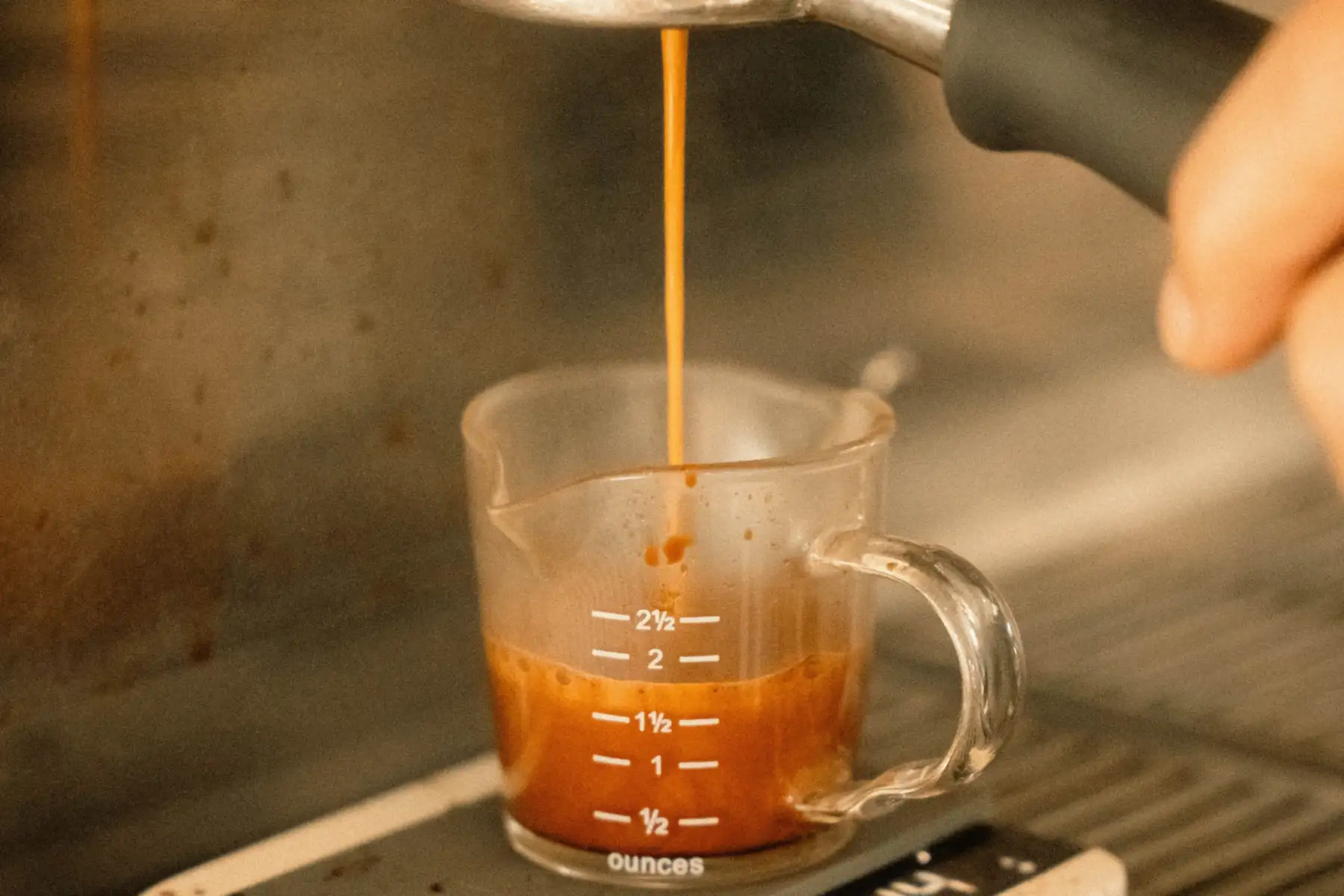
The ratio also names the shot. In a 2014 article on its US site, La Marzocco calls 1:1 to 1:2 a ristretto, 1:2 to 1:3 a normale and 1:3 to 1:4 a lungo, and says there is wiggle room.
Four recipes compared
All four use about 1:2, but the dose and time differ:
- Methodical Coffee: 18 g in, 36 g out, in 32 seconds.
- Cameron and colleagues, in the journal Matter (2020): 20 g in, 40 g out, which they call a representative modern espresso recipe. Their shot times got shorter as the grind got coarser.
- Seattle Coffee Gear: 14 g in, 28 g out, in 20–30 seconds, aiming for about 25 seconds at first.
- La Marzocco Home: 17 g in, 34 g out, for a light roast, timed from when water first touches the coffee. Its first shot took 55 seconds and tasted “pretty intense”; after a coarser grind it took 40 seconds.
Seattle Coffee Gear’s grind guide uses the same 18 g in and 36 g out, in 25–30 seconds. So 18 g in and 36 g out in about 25–30 seconds is a fair start, and it is our baseline. The last recipe shows why time is a clue, not a rule: a light roast ground very fine can run well past 30 seconds.
It is also close to what cafés do. In the Barista Guild of America’s 2017 espresso survey, reported by the Specialty Coffee Association, most baristas dosed 18–20 g, and the average shot came out at 36.5 g, about 1:2, in 25–30 seconds; 82% weighed the yield.
Espresso targets from five sources
The numbers below come from a heritage definition, a survey of baristas, a coffee trade association, a machine maker and a peer-reviewed study. They agree on a ratio near 1:2 and differ most on time. The table is a summary, and our own baseline follows it, apart from the sources.
| Source | Dose | Yield | Time | Water |
|---|---|---|---|---|
| SCA heritage definition | 7–9 g single | 25–35 ml single | 20–30 s | 90.5–96.1 °C |
| Barista Guild survey, 2017 | 18–20 g for most | 36.5 g average | 25–30 s for 51% | 94 °C average |
| National Coffee Association | not stated | 1:2 by weight | 20–30 s | nearly boiling |
| La Marzocco Home, light roast | 17 g | 34 g (1:2) | 40 s, coarser grind | 93–96 °C |
| Cameron et al., 2020 | 20 g, or 15 g | 40 g | shorter when coarser | 92 °C |
Our baseline, for comparison: 18 g in and 36 g out (1:2), in about 25–30 s, with water at about 90–96 °C (195–205 °F). It sits within, or at the edge of, the sources’ ranges rather than being one of them.
A few details the table leaves out: the 2017 survey had 275 respondents, whose ratios ran from 1:1.5 to 1:2.5, and 9 bar was the most common pressure; Cameron and colleagues brewed at 6 bar, not 9; and La Marzocco Home gives 51 g out for a 1:3 lungo.
The study’s lower-dose recipe used 15 g in and 40 g out, ground much coarser. The authors say this can give very fast shots, under 15 seconds, a lower concentration and a different flavor. A café that adopted it used 25% less coffee per drink. It is a research result worth knowing, not our baseline.
What you need
- An espresso machine and a grinder that can grind fine.
- A scale that reads to 0.1 g, and a timer.
- A cup that fits on the scale under the machine.
Safety. Espresso machines hold hot, pressurized water and steam, which can burn and scald. Keep your hands clear of the group head and the portafilter while the machine is on, because both stay hot after use. Do not force a portafilter that will not release; follow your machine’s manual.
| Dose | 18 g of coffee, ground fine |
|---|---|
| Yield | 36 g of espresso in the cup (1:2) |
| Time | about 25–30 seconds from the start of the shot |
| Water | about 90–96 °C (195–205 °F) at the machine |
| Weigh | the coffee before, the espresso as it pours |
A starting point, not a rule. Recipes differ with the coffee, the basket and the machine.
Step 1: Weigh the dose
Weigh 18 g of coffee, or the amount your basket is made for. Grind it fine: Methodical Coffee compares the texture to ground cinnamon.
Step 2: Level and tamp
Shake or tap the basket so the bed is level, then press it flat with the tamper. Tamp the same way every time, so you change only one thing at a time.
Step 3: Start the shot
Lock in the portafilter, set the cup on the scale, zero it, and start the shot and the timer together.
Step 4: Stop at the yield
Stop the shot when the scale reads about 36 g. Note the time.
Step 5: Taste and note it
Stir the espresso before you taste it: Methodical Coffee says stirring mixes the crema with the coffee underneath, for a more balanced flavor. Write down the dose, yield and time, so you can change one thing next time.
Where recipes differWhat counts as a standard shot
The question
Is an espresso a set volume, or a weighed ratio?
CMC verdict
Start with a weighed recipe, such as 18 g in and 36 g out, and treat 25–30 seconds as a clue to the grind, not a definition. The heritage figures describe what an espresso is; they are not a number your shot has to hit.
Try it yourself
Pull three shots of the same coffee with the same dose and yield, weighed, and write down each time. If the times differ by more than a few seconds, the change is in your routine, not the recipe.
See the sources
Source A
The Specialty Coffee Association’s heritage definition
A 25–35 ml single from 7–9 g of coffee (14–18 g, and twice the volume, for a double), made with water at 195–205 °F at 9–10 atmospheres, in 20–30 seconds.
Source B
The 2017 Barista Guild of America survey
Most baristas dosed 18–20 g and used about 1:2. The average shot came out at 36.5 g in 25–30 seconds, and 82% weighed the yield.
Source C
La Marzocco Home, for a light roast
17 g in and 34 g out, timed from when water first touches the coffee. Its example shots took 55 seconds, then 40 after a coarser grind.
Why the numbers differ
The heritage definition describes espresso by volume and time. Cafés now weigh a bigger dose and its yield, and some light-roast recipes run well past the old time window. Each describes a different setup, not a mistake.
Sources for this section
Troubleshooting
The shot ran much faster than 25 seconds
The grind is probably too coarse. Grind a little finer next time. Our dial-in guide shows how.
The shot ran much slower than 30 seconds
The grind is probably too fine. Grind a little coarser.
It tastes sour or bitter
Our guide to sour or bitter espresso lists the usual causes and the first fix for each.
Frequently asked questions
What is a 1:2 espresso ratio?
It means the espresso in the cup weighs twice as much as the dry coffee: for example, 18 g in and 36 g out. It was the average ratio in a 2017 Barista Guild of America survey, and La Marzocco Home calls a 1:2 shot a normale.
How long should an espresso shot take?
Many recipes aim for about 25–30 seconds, as did about half the baristas (51%) in a 2017 Barista Guild of America survey. The Specialty Coffee Association’s heritage definition and the National Coffee Association give about 20–30 seconds. Some modern recipes for light roasts run much longer, so treat time as a guide.
Why weigh the espresso instead of measuring it in ounces?
A scale gives a number you can repeat from shot to shot. All four recipes in this guide give the yield in grams.
What water temperature should an espresso machine use?
The Specialty Coffee Association’s heritage definition gives 195–205 °F (90.5–96.1 °C), and the baristas in the 2017 Barista Guild of America survey averaged 200.3 °F. La Marzocco Home suggests 93–96 °C (200–205 °F) for light roasts.
- Dose is the coffee that goes in; yield is the espresso that comes out; time is how long the shot runs.
- A common start is 18 g in and 36 g out, a 1:2 ratio, in about 25–30 seconds.
- Weigh the espresso, not just the coffee: the yield sets how strong the shot is.
- Treat the time as a clue to the grind, and let taste have the last word.
Sources
Pages used for the claims above.
- National Coffee Association, Espresso.
- Specialty Coffee Association, Defining the Ever-Changing Espresso (25 Magazine, issue 3: the heritage definition and the 2017 Barista Guild of America survey).
- Methodical Coffee, How to pull a shot of espresso.
- Methodical Coffee, How to enjoy espresso.
- Cameron et al., Systematically Improving Espresso: Insights from Mathematical Modeling and Experiment, Matter (2020).
- Seattle Coffee Gear, How to Dial in Your Espresso Shot - Grind Size.
- Seattle Coffee Gear, Dialing In Your Espresso Shots.
- La Marzocco Home, Dialling In A Modern Espresso.
- La Marzocco Home (US site), Brew Ratios Around the World (Ben Blake and Scott Callender, 2014).
Published Updated
See sourcesReport a correction — fixes are logged in the Updated date.