
Article
How to Choose a Kettle for Coffee
Edited and reviewed by Coffee Made Clear TeamUpdated 6 min read
For pour-over, choose a kettle with a gooseneck spout and a way to reach about 93 °C.
A temperature setting does that for you; otherwise use a thermometer, or let boiled water rest about a minute.
Then check the capacity against your largest brew, a balanced handle, and what the inside is made of.
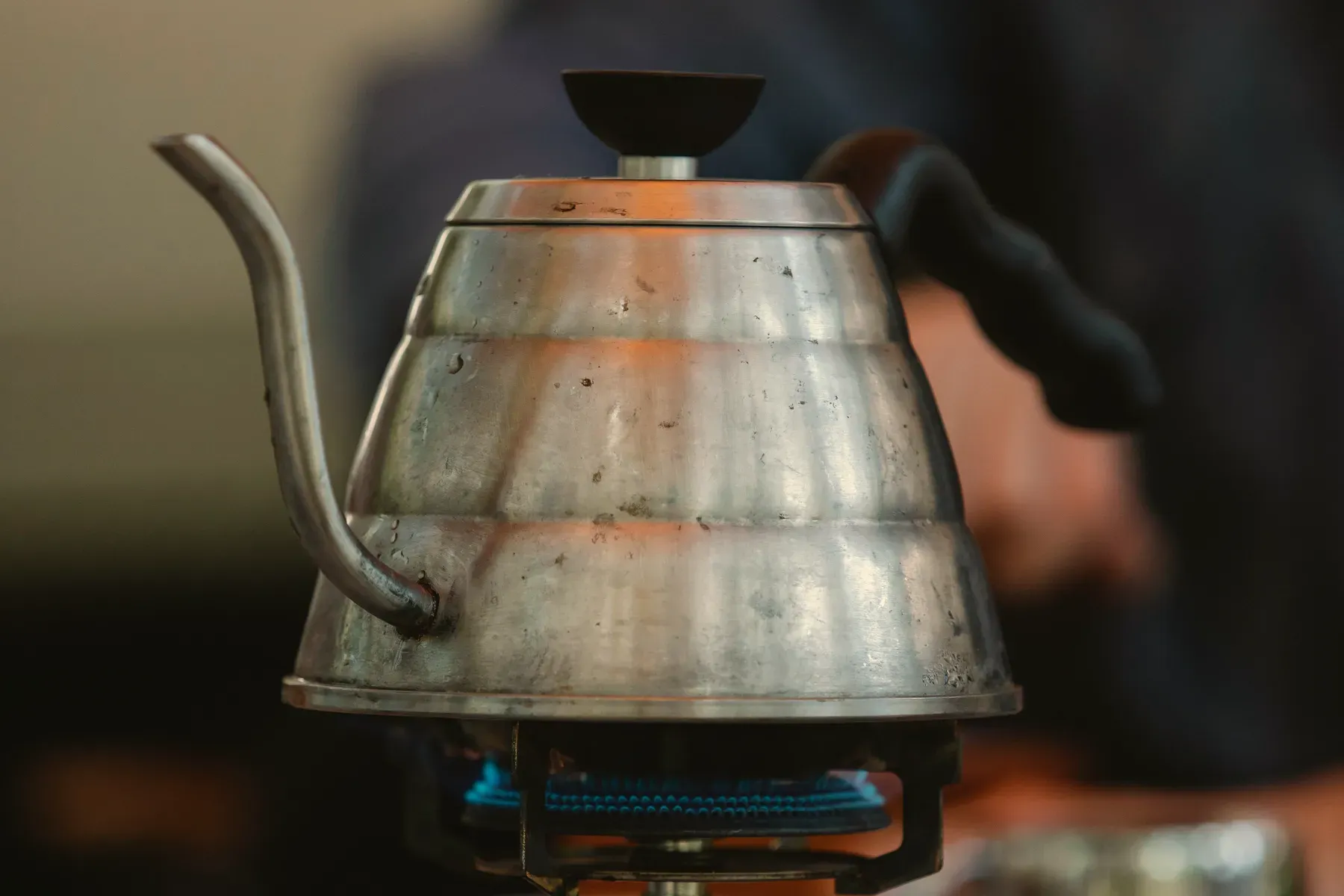
Any kettle can boil water. For pour-over, though, how the water leaves the kettle matters as much as how hot it is: a slow, aimed pour wets the coffee evenly. For French press or tea, almost any kettle will do.
In this guide we set out what to look for in a kettle for coffee and why, from trade associations, kettle makers, roasters and published research. It gives criteria, not product picks.
What to look for
| Look for | Why it matters | What to check |
|---|---|---|
| A gooseneck spout for pour-over | A narrow gooseneck lets you pour slowly and aim the water; short, wide spouts pour fast and are hard to control, though they are fine for French press and tea. | The spout shape, and whether it has a flow restrictor. |
| Temperature control, or a thermometer | Filter coffee is usually brewed at about 93 °C, give or take 3 °C; without a setting you need a thermometer or a short rest after the boil. | A temperature setting and hold mode, or room for a thermometer. |
| Capacity for your largest brew | You need the brew water plus water to rinse the filter, but a full, oversized kettle is heavy to pour slowly. | The capacity against the largest brew you make, plus rinse water. |
| Electric or stovetop, to fit your kitchen | Electric kettles heat fast and can hold a temperature and switch themselves off; stovetop kettles have no electronics to fail and work in a power cut. | Your hob, and whether you want temperature control built in. |
| Stainless steel or glass where the water sits | A peer-reviewed study found new polypropylene kettles release plastic particles into boiled water, most in the first boils. | What the inside of the kettle and its lid are made of. |
| A balanced, comfortable handle | A pour-over means holding a full kettle out for a few minutes; a balanced handle makes a slow, steady pour easier. | The filled weight, the handle and a lid that stays put. |
| Auto shut-off, and an inside you can descale | Auto shut-off stops a forgotten kettle boiling dry, and limescale slows heating and throws off temperatures. | Auto shut-off or boil-dry protection, and an inside you can see and clean. |
Spout and pour
The National Coffee Association says short-spouted kettles pour faster and are harder to control, and that a gooseneck helps you control the flow. Fellow says a gooseneck gives precision over the flow, direction and placement of the water, and that a standard spout is usually enough for French press, tea and cooking. Both electric and stovetop kettles come with goosenecks. Intelligentsia’s pour-over guide pours slowly, at 8 to 10 g a second, from a slow-pour gooseneck. Fellow also suggests checking whether a kettle has a flow restrictor. Our pour-over guide shows the pour.
Temperature
The National Coffee Association cites the Specialty Coffee Association’s standard: the best water temperature before pouring is 93 °C, give or take 3 °C. Roasters land in the same place: Stumptown heats water to just off the boil, about 205 °F, and Counter Culture Coffee uses 200 °F. Without a built-in thermometer, the National Coffee Association suggests keeping one to hand, or bringing the water to a boil and letting it rest for a minute.
An exact number matters less than it seems. Researchers at UC Davis found that brewing at 87, 90 or 93 °C made little difference to the taste when the strength and extraction were matched. The Specialty Coffee Association notes that temperature still changes how fast coffee extracts. A temperature setting helps you repeat a recipe; it is not the only route to a good cup.
Some electric kettles have a hold mode that keeps the water at the set temperature for a while; check the maker’s manual for how long. Fellow says simple on/off thermostats overshoot and undershoot the set point, and that a kettle that boils fast may not land on the exact temperature you set. A PID controller holds the temperature more closely: Fellow says its own PID kettles stay within ±0.3 °C of the set point.
Capacity and handle
Fellow says to match a kettle’s capacity to how much water you normally heat rather than defaulting to the largest size, and to check the filled weight, the handle and a secure lid. A kettle needs your brew water plus water to rinse the filter: Counter Culture Coffee’s 16 oz pour-over uses 500 g of water before any rinse. Fellow says a counterbalanced, comfortable handle is essential for a slow pour; holding a full kettle out for a few minutes is where a poor handle shows.
Electric or stovetop
Electric kettles heat faster with more wattage, can hold a set temperature, and tend to include auto shut-off and boil-dry protection, Fellow says. Their bases must stay dry, and Breville notes they will not work in a power cut. Stovetop kettles have no electronics to fail and can last many years, but you manage the temperature yourself: a thermometer, pulling the kettle off the heat at the right moment, or letting the water cool before you pour.
Materials and limescale
A peer-reviewed study found that new polypropylene kettles released nano- and microplastic particles into boiled water. Release was highest in the first boils and still detectable after 150. Rinsing removed fewer particles than boiling and pouring away the first few fills, and the authors suggest designs with more glass or stainless steel. The University of Queensland, where the work was done, says exposure remains poorly understood. If you want to limit plastic contact, look for a kettle whose water path is stainless steel or glass.
Hard water leaves limescale. Fellow says scale can cause inaccurate temperatures and slow heating, and heavy deposits can damage the heating element. It suggests descaling about monthly with hard water and every two to three months with soft water. Our guide to coffee water explains hardness.
Safety. Boiling water and steam cause burns and scalds. Keep the spout pointed away from you and from other people, keep children and pets away, and do not open the lid while the water is boiling. A full kettle is heavy: lift it by the handle with a firm grip, and put it down before you adjust anything. After you descale with vinegar or citric acid, rinse the kettle several times with clean water and throw away the first fill you boil, so no descaler ends up in your coffee. Follow the descaling and cleaning steps in your kettle’s own manual.
Frequently asked questions
What water temperature do I need for pour-over?
About 93 °C, give or take 3 °C, from the Specialty Coffee Association standard that the National Coffee Association cites. Roasters use about 200 to 205 °F. Without a temperature setting, the National Coffee Association says to bring the water to a boil and let it rest for a minute.
Do I need a gooseneck kettle?
For pour-over it helps: the National Coffee Association says short spouts pour faster and are harder to control. For French press, tea or cooking, Fellow says a standard spout is usually enough.
Electric or stovetop?
Electric kettles heat faster, can hold a set temperature and tend to have auto shut-off. Stovetop kettles have no electronics to fail and work in a power cut, but you watch the heat and the temperature yourself.
Are plastic kettles a problem?
One peer-reviewed study, which tested polypropylene kettles only, found new kettles released nano- and microplastic particles into boiled water, most in the first boils and still detectable after 150. The researchers say exposure is poorly understood. If you want to avoid plastic contact, look for stainless steel or glass where the water sits.
How often should I descale a kettle?
Fellow suggests about once a month in hard-water areas and every two to three months with soft water, using equal parts vinegar and water or a citric acid solution. Limescale slows heating and can throw off temperature readings. Rinse the kettle well with clean water afterwards, and boil and throw away the first fill.
- For pour-over, a gooseneck spout lets you pour slowly and aim the water; for French press or tea, a standard spout is usually enough.
- Filter coffee is usually brewed at about 93 °C, give or take 3 °C. Without a temperature setting, boil the water and let it rest about a minute.
- Temperature matters less than people think: in a UC Davis study, 87, 90 and 93 °C tasted much the same when strength and extraction were matched.
- Buy for your largest brew plus rinse water, not the biggest kettle; a full kettle is heavy to pour slowly.
- A peer-reviewed study found new polypropylene kettles shed plastic particles into boiled water; stainless steel or glass avoids that contact.
Sources
Pages used for the claims above.
- National Coffee Association, Pour-over coffee: spouts, water temperature and resting the water.
- Specialty Coffee Association, How Hot is Hot Enough? Brew Temperature, Sensory Profile, and Consumer Acceptance of Brewed Coffee, 25 magazine.
- Specialty Coffee Association, Just Published: Brewing Temperature and the Sensory Profile of Brewed Coffee.
- Batali, Ristenpart and Guinard, Brew temperature, at fixed brew strength and extraction, has little impact on the sensory profile of drip brew coffee, Scientific Reports (2020).
- Shi and colleagues, Release of nanoplastic from polypropylene kettles, npj Emerging Contaminants (2025).
- The University of Queensland, Australians are drinking plastic particles in their tea, UQ research finds.
- Fellow, Best gooseneck kettle for coffee: how to choose.
- Fellow, Electric vs. Stovetop Kettles: Which to Choose?.
- Fellow, What’s The Point of A PID Controller In An Electric Kettle?.
- Fellow, Is Descaling Necessary? How Often to Descale a Kettle.
- Breville, Electric vs. stovetop kettle: Which should you buy?.
- Stumptown Coffee Roasters, pour-over brew guide: water just off the boil.
- Counter Culture Coffee, Quick + Easy Pour Over: 500 g at 200 °F.
- Intelligentsia Coffee, Pour Over Brew Guide: pour rate.
Published Updated
See sourcesReport a correction — fixes are logged in the Updated date.