
Article
Single-Origin vs Blend Coffee
Edited and reviewed by Coffee Made Clear TeamUpdated 5 min read
A single-origin coffee comes from one place.
That place might be a whole country, one region, one farm or even a single plot. A blend mixes coffees from more than one place.
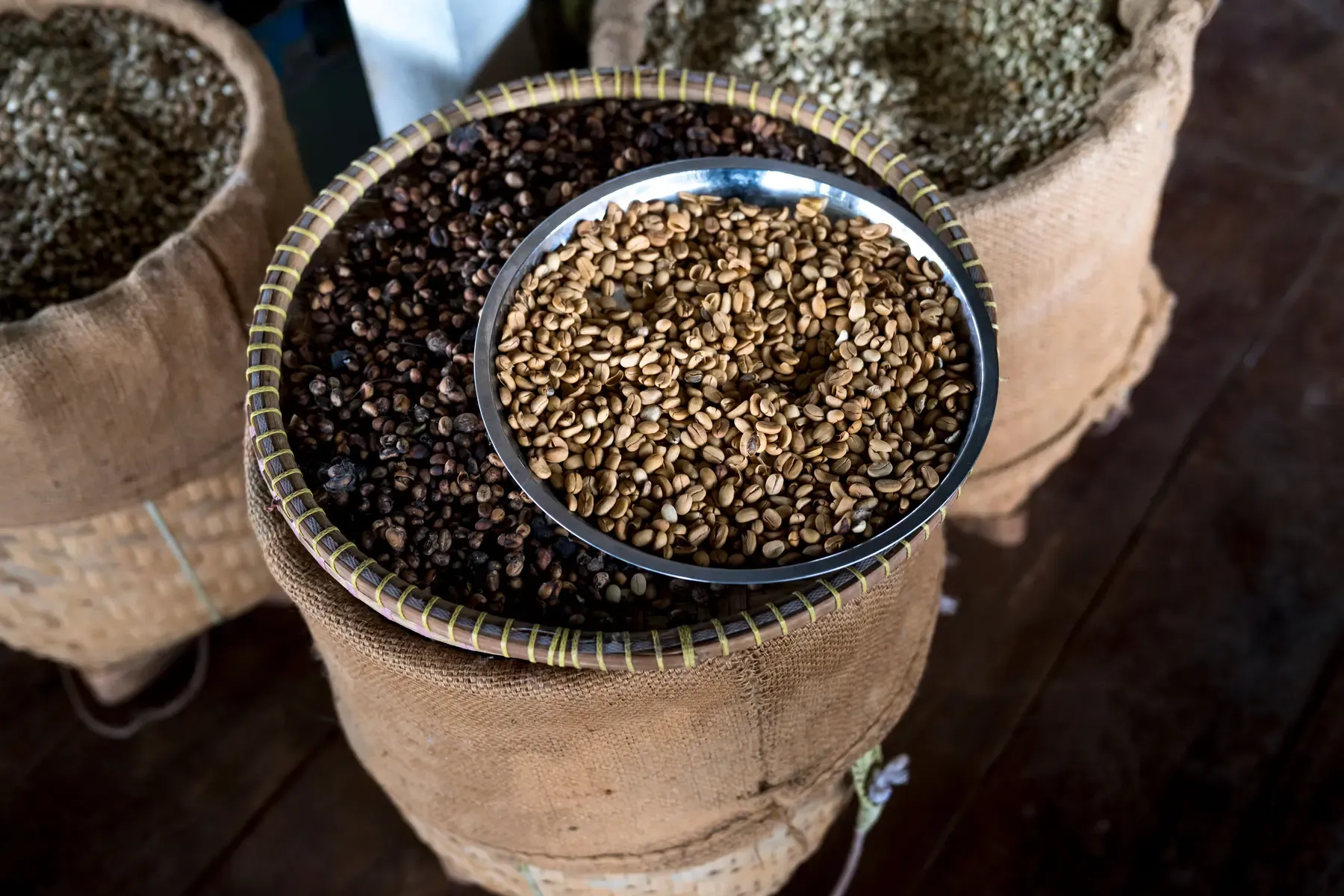
Roasters often blend to keep a coffee's taste steady all year, because each harvest is only available for part of it. Single origins let you taste one place, and each is on sale only while its harvest lasts. Neither is better by label, so choose by taste and how you brew.
“Single origin” and “blend” are two of the most common words on a coffee bag. They sound like a quality ranking, but they are not. They tell you where the coffee came from, and how many places went into it.
In this guide we explain what each label means, why roasters make blends, and how to choose between them for the way you brew.
What single origin means
A single-origin coffee comes from one place. The catch is that “one place” can be large or small. A bag might name a whole country, a region inside it, a single farm, or even one plot on that farm.
A summary of coffee quality tiers compiled for the International Coffee Organization shows the range. Mid-range coffees often take a regional approach and are “frequently used as ‘single origin’.” The top tier names a specific region, farm, variety, altitude and producer, with traceability down to the farm plot.
So the more detail a bag gives, the more you know about where your coffee grew. The word “single origin” alone tells you less than you might think.
What a blend is, and why roasters make one
A blend mixes coffees from more than one place. Roasters build it to a taste, then keep that taste steady.
Consistency is a big reason. Each coffee is only available from certain countries at certain times of year. A roaster can profile a blend to one flavor and swap a component when a harvest runs out. One UK roaster’s espresso blend uses a Colombian coffee for half the year and a Rwandan coffee for the other half.
Blends can also be designed for a goal. Researchers have mixed Arabica, Robusta and decaf beans to make blends with less caffeine. Blends turn up from everyday coffee to specialty espresso.
What each tends to offer
A single origin shows you one place, one harvest and often one way of processing. It is on sale only while that harvest lasts. When it is gone, it is gone.
A blend aims for balance and a taste you can buy again next month. A coffee trade site notes that blends are often more popular for espresso, because they can be built to work with milk. Will Corby, a roaster quoted by Perfect Daily Grind, says single-origin espresso needs coffees with balance at their core, which is rare.
Place is only one part of flavor. In a study of 13 high-quality coffees from one small Colombian region, differences were mostly small and could not be pinned on location. The plant variety, processing and roast matter too. Our guide to coffee origins covers this in more depth.
What you need
- One single-origin coffee and one blend, at a similar roast level.
- Your usual brewer and recipe.
- A notebook or phone note.
Step 1: Start from how you brew
For espresso or milk drinks, a blend made for espresso is a good place to start. For black filter coffee, try a single origin to taste one place.
Step 2: Read how much the label tells you
A country name alone is a wide single origin. A region, farm or lot tells you more. A blend may list its components, or only a taste.
Step 3: Brew both the same way
Use the same dose, water, grind and time, so only the coffee changes.
Step 4: Taste and write it down
Note what you liked, and the origin or blend name, the roast and the process.
Step 5: Buy again, or explore
If you want the same cup next month, a blend is the safer bet. If you liked a single origin, look for coffees from the same place or with the same process.
Troubleshooting
My favorite single origin is sold out
That is normal. Each harvest runs out. Look for the same region or process from the next harvest, and treat it as a new coffee.
A blend tastes flat to me
Try a single origin with a light or medium roast, or a blend built for filter coffee rather than espresso.
I cannot tell them apart
Brew them side by side and focus on one thing at a time, such as sweetness or acidity.
Frequently asked questions
Is single-origin coffee better than a blend?
Not by label. Blends turn up from everyday coffee to specialty espresso, and a single origin can name anything from a country to one farm plot. A single origin shows one place; a blend aims for a balanced, steady cup. Let your taste decide.
Why do roasters make blends?
Often for consistency. Each coffee is only available at certain times of year, so a roaster can build a blend to a taste and swap components as harvests change.
Does single origin mean one farm?
Not always. A single origin can name a country, a region, a farm or a single plot. The more detail the bag gives, the more you know about where the coffee came from.
Which is better for espresso?
Many espresso coffees are blends, built for balance and for milk drinks. Will Corby, a roaster quoted by Perfect Daily Grind, says single-origin espresso needs coffees with balance at their core, which is rare. Try both and see.
- Single origin means the coffee comes from one place. That place can be a whole country or one plot on one farm.
- A blend mixes coffees from more than one place, often to keep the taste steady all year.
- Neither is better by label. Single origins show one place; blends aim for balance and consistency.
- Choose by taste and use, and write down what you liked.
Sources
Studies and pages used for the claims above.
- International Coffee Organization, Focus Group on Specialty Coffee, Existing definitions of specialty coffee (FGSC 03/24, 2024), quoting the International Trade Centre’s quality tiers.
- Tasmin Grant, Roasting essentials: Exploring seasonal coffee blends, Perfect Daily Grind (2021).
- di Donfrancesco, Gutierrez Guzman and Chambers, Similarities and differences in sensory properties of high quality Arabica coffee in a small region of Colombia, Food Research International (2019).
- Šeremet et al., Antioxidant and Sensory Assessment of Innovative Coffee Blends of Reduced Caffeine Content, Molecules (2022).
- Bollen et al., Sensory profiles of Robusta coffee (Coffea canephora) genetic resources from the Democratic Republic of the Congo, Frontiers in Sustainable Food Systems (2024).
Published Updated
See sourcesReport a correction — fixes are logged in the Updated date.