
Article
Cortado vs Macchiato
Edited and reviewed by Coffee Made Clear TeamUpdated 5 min read
An espresso macchiato is a shot with about two teaspoons of milk foam on top.
A cortado is a double shot with an equal amount of steamed milk.
Both amounts are Breville’s.
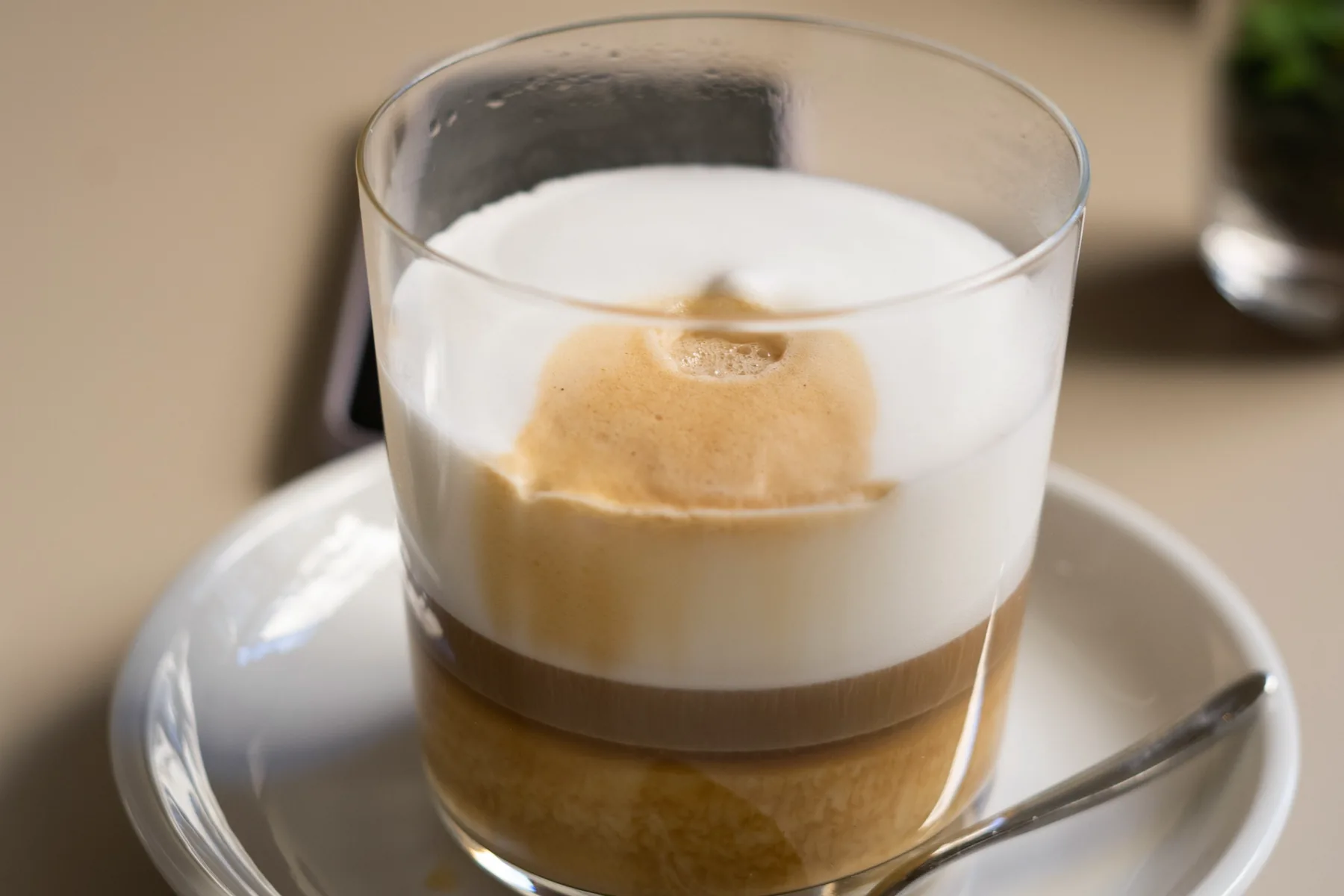
A latte macchiato is milk with a shot poured in.
The cortado and the macchiato are the smallest milk drinks on a café menu, and the easiest to mix up. Both start with espresso. The difference is how much milk goes in, and in what form.
In this guide we compare how Breville, De’Longhi and Lavazza build them, add the latte macchiato that shares the name, and show how to make each at home. For the bigger milk drinks, see our latte, cappuccino and flat white guide.
The three drinks
Espresso macchiato. Macchiato means marked or stained in Italian. De’Longhi describes the drink as a shot of espresso with a dash of hot milk or dense froth on top, and says the milk softens the intensity of the espresso. Breville spoons about two teaspoons of microfoam onto the shot; Lavazza pours a small amount of foamed milk into the centre, so the spot shows on the surface. Coffee Review, a coffee publication, describes it the same way: a serving of espresso “stained” with a small quantity of hot, frothed milk.
Cortado. Breville pulls a double shot into a small or medium glass and tops it with an equal amount of microfoamed milk, and notes that the ratio of coffee to milk changes from region to region. 1Zpresso, a grinder maker, describes the milk as lightly steamed, with minimal microfoam, in a 1:1 ratio, served in a small glass of about 4 oz.
Latte macchiato. Here the milk is “marked” by the coffee instead. De’Longhi describes hot steamed milk stained with a small amount of espresso or ristretto, served in a caffè latte glass with the milk at 55–60 °C. Lavazza says a larger amount of foamed milk goes in first, with the shot on top, and Coffee Review describes a glass of hot frothed milk with a serving of espresso slowly dribbled in.
| Drink | Espresso | Milk | Glass |
|---|---|---|---|
| Espresso macchiato | One shot (De’Longhi) | A dash of hot milk or dense froth; about two teaspoons of microfoam (Breville) | A demitasse, about 2–3 fl oz (Breville) |
| Cortado | A double shot (Breville) | About the same amount (Breville), lightly steamed (1Zpresso) | A small glass, about 4 oz (1Zpresso) |
| Latte macchiato | A shot of espresso or ristretto | A glass of hot frothed milk, 55–60 °C (De’Longhi) | A caffè latte glass (De’Longhi) |
Names vary
Cafés and countries use these names differently. Lavazza says Italy sometimes calls a two-shot macchiato a doppio macchiato; in Australia a single-shot macchiato is a short macchiato and the two-shot version a long macchiato; and in Portugal a similar drink is a café pingado. The latte macchiato, milk marked by espresso, adds to the confusion. Our suggestion: order by what is in the cup, a shot with a spoonful of foam, a shot with about as much milk, or a glass of milk with a shot poured in, and ask if the menu is not clear.
What you need
- An espresso machine with a steam wand.
- Fresh, cold milk and a small steaming jug.
- A small glass or cup, and a teaspoon.
| Espresso macchiato | one shot, plus about two teaspoons of milk foam |
|---|---|
| Cortado | a double shot, plus about the same amount of steamed milk |
| Latte macchiato | a glass of hot frothed milk, with a shot poured in |
| Milk (macchiato and cortado) | steamed to about 60–65 °C (140–150 °F), as Breville does |
Cafés and countries use these names differently. These are starting points.
Step 1: Pull the espresso
A single shot for a macchiato, a double for a cortado. De’Longhi uses about 7–8 g of coffee for a single shot, extracted in about 18–23 seconds; our espresso basics explain dose and time.
Step 2: Steam a little milk
Steam a small amount of milk to about 60–65 °C (140–150 °F), Breville’s range for its macchiato. For a cortado, keep the foam thin. Our milk steaming guide shows how.
Safety. Steam and hot milk can burn. Keep your hands clear of the wand tip, and point the wand into a jug or cloth when you purge it. Let the pitcher cool for a moment before you drink.
Step 3: For a macchiato, spoon on the foam
Spoon about two teaspoons of the foam onto the espresso, as Breville does, so it marks the surface.
Step 4: For a cortado, pour in the milk
Pour in about as much steamed milk as there is espresso, and serve it straight away.
Troubleshooting
It tastes too strong
Make a cortado instead of a macchiato, or add a little more milk to the cortado. Cafés vary the ratio, as Breville notes.
The milk sinks straight into the coffee
The foam is too thin for a macchiato. Steam with a little more air, then spoon the foam on top.
It tastes bitter or sour
Fix the espresso first: our sour or bitter espresso guide explains how.
Frequently asked questions
What does macchiato mean?
Marked, stained or spotted, in Italian. Lavazza, De’Longhi and Breville all describe the foam or milk as a mark on the espresso.
What does cortado mean?
1Zpresso, a grinder maker, says it comes from the Spanish cortar, to cut: the milk cuts the espresso. It describes the drink as espresso with lightly steamed milk in a 1:1 ratio.
Does a cortado taste stronger than a macchiato?
Usually not, in our reading. A macchiato has only a spoonful of foam, so it tastes closer to plain espresso. A cortado has about as much milk as espresso, so it is softer, even with a double shot.
What is a Gibraltar?
1Zpresso says the name came from a 4.5 oz glass that Blue Bottle Coffee began using in San Francisco in the early 2000s, and that some US cafés use it for a cortado.
Is a latte macchiato the same as a latte?
Not quite. Lavazza contrasts them: in a café latte the steamed milk goes onto the espresso; in a latte macchiato a larger amount of foamed milk comes first and the espresso goes on top.
- An espresso macchiato is espresso “marked” with a little milk foam: Breville spoons on about two teaspoons.
- A cortado is espresso with about the same amount of steamed milk: Breville uses a double shot.
- A latte macchiato turns it around: a glass of hot frothed milk, with a shot of espresso poured in.
- Names vary. Lavazza lists a short and a long macchiato in Australia, and other names elsewhere.
Sources
Pages used for the claims above.
- Breville, Essential Cortado and Macchiato.
- De’Longhi, The Perfect Espresso Macchiato and How do I make a latte macchiato?
- Lavazza, Macchiato Definition: Vocabulary and Curiosities and How to make a macchiato coffee.
- Coffee Review, Espresso Cuisines: Traditional Drink Descriptions: the espresso macchiato and latte macchiato.
- 1Zpresso, What is a Cortado? (2025).
Published Updated
See sourcesReport a correction — fixes are logged in the Updated date.