
Article
How Much Caffeine Is in Coffee?
Edited and reviewed by Coffee Made Clear TeamUpdated 5 min read
A typical 8 fl oz cup of brewed coffee has about 95 mg of caffeine.
That is our arithmetic from data published by the USDA. A 1 oz shot of espresso has about 63 mg, the National Coffee Association says, though real cups vary a lot.
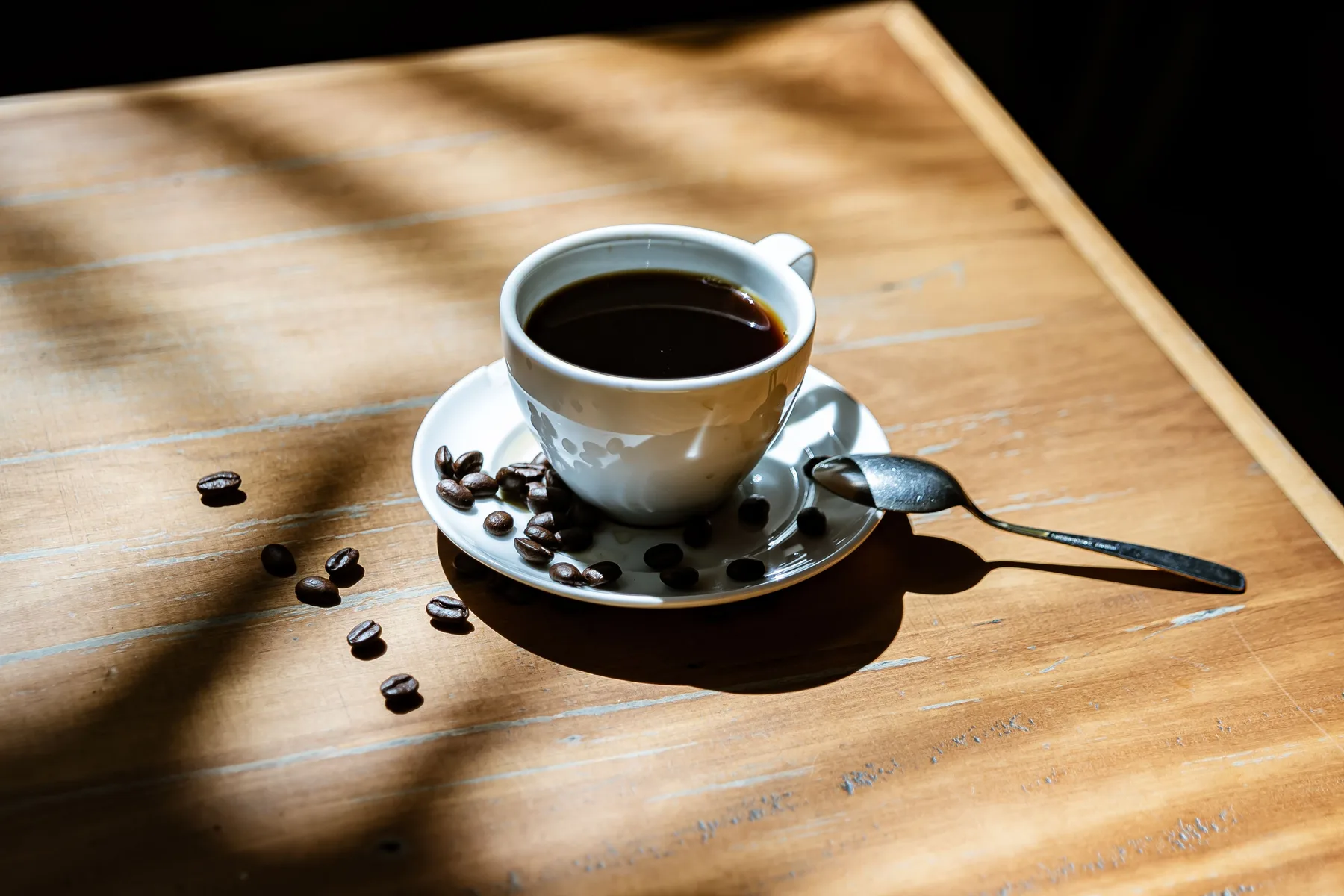
The FDA gives 113–247 mg for a 12 fl oz cup of regular brewed coffee, and 2–15 mg for an 8 fl oz cup of decaf. It cites 400 mg a day as an amount not generally associated with negative effects for most adults, about two to three 12 fl oz cups. It recommends talking to your health care provider if you are pregnant, trying to become pregnant or breastfeeding, or are concerned about a condition or medication.
Caffeine is the reason many of us drink coffee in the morning. How much is in your cup depends on what you brew, how much coffee you use and how big the cup is.
In this guide we give typical figures for brewed coffee, espresso and decaf, explain what changes them, and show how to estimate your own intake. This is a guide to coffee, not medical advice.
Typical amounts
These are typical figures from public sources:
- Brewed coffee: USDA data lists 40 mg of caffeine per 100 g of brewed coffee. An 8 fl oz cup weighs about 237 g, so that is about 95 mg, by our arithmetic. The National Coffee Association gives the same 95 mg.
- A bigger cup: the FDA gives 113–247 mg for a 12 fl oz cup of regular brewed coffee, a wide range.
- Espresso: the National Coffee Association gives 63 mg in a 1 oz shot. USDA data comes out about the same. That is a single shot. The 18 g in, 36 g out recipe in our espresso basics guide is a double, so count it as closer to two shots than one.
- Decaf: the FDA gives 2–15 mg for an 8 fl oz cup and notes that decaf still contains some caffeine.
The FDA figure for adults
For most adults, the FDA cites 400 mg a day as an amount not generally associated with negative effects, about two to three 12 fl oz cups of coffee. It notes wide variation in how sensitive people are to caffeine. It recommends talking to your health care provider if you are pregnant, trying to become pregnant or breastfeeding, or are concerned about a condition or medication. The figure is for adults; for children and teens, the FDA suggests talking with a health care professional.
What changes the caffeine in your cup
A 2021 review of caffeine studies found many factors at work, including the species, the roast, the grind, the water temperature and the ratio of water to coffee. In practice, these matter most:
- How much coffee you use. More coffee in, more caffeine out. Our ratio guide shows how much coffee goes into a cup.
- How big the cup is. A 12 fl oz mug holds half as much again as an 8 fl oz cup.
- The species. Green Robusta beans carry roughly twice the caffeine of Arabica, as our Arabica vs Robusta guide explains.
- The roast, a little. A 2024 study found that, brewed the same way, dark roasts generally gave less caffeine than light and medium roasts; yet at the same extraction, dark roasts had more. So the roast is a smaller lever than the amount of coffee.
- The method. In a 2017 study, coarse-ground cold brew had substantially more caffeine than hot brew from the same coffee and grind. Espresso is concentrated but small.
| Study | What was tested | Sample | Finding |
|---|---|---|---|
| Lindsey et al. (2024), Scientific Reports | AeroPress brews (10 g coffee to 150 g water) for 1, 2 or 10 minutes, caffeine measured by HPLC | Two Ethiopian coffees at five roast levels; 90 brews | Brewed the same way, dark roasts generally had less caffeine than light and medium roasts; at the same extraction, dark roasts had more. Cups held about 134–165 mg per 8 fl oz. |
| Fuller and Rao (2017), Scientific Reports | Cold brew (35 g coffee in 350 mL water) sampled from 15 minutes to 24 hours, with a hot French press for comparison | One Kona coffee at a medium and a dark roast, each at two grinds; brews in triplicate | Medium roasts gave more caffeine in cold brew, but at a medium grind the medium–dark difference was not statistically significant. |
CMC verdict: the roast is a small lever. Brewed the same way, darker roasts had a little less caffeine or no significant difference; matched for extraction, they had more. To change how much caffeine you get, change how much coffee you use.
What you need
- The size of your usual cup or mug, in fluid ounces.
- How many cups you drink in a day, and of what.
- The table above.
Caffeine, cup by cup
- Brewed coffee
- about 95 mg in 8 fl oz (USDA data, our arithmetic)
- Brewed, 12 fl oz
- 113–247 mg (FDA)
- Espresso
- about 63 mg in a 1 oz shot (NCA)
- Decaf
- 2–15 mg in 8 fl oz (FDA)
- FDA figure
- 400 mg a day: not generally associated with negative effects for most adults
Real cups vary with the coffee, the amount you use and the cup size. These are typical figures, so treat them as an estimate.
Step 1: Name the drink
Brewed coffee, espresso, cold brew or decaf: each has a different typical figure.
Step 2: Check the size
Measure your usual mug. Many mugs hold more than 8 fl oz.
Step 3: Use a typical figure
Use about 95 mg per 8 fl oz of brewed coffee, or about 63 mg per 1 oz espresso shot; count an 18 g double as about two shots. Treat it as an estimate.
Step 4: Add up the day
Count every cup, including espresso drinks and iced coffee.
Step 5: Adjust if you want less
Use a smaller cup, a little less coffee, or switch some cups to decaf.
Troubleshooting
Some cups seem stronger than others
Cups vary a lot, from 113 to 247 mg for 12 fl oz in the FDA’s figures. A stronger brew or a bigger mug can mean much more caffeine.
I want the taste with less caffeine
Try decaf, or half decaf and half regular. Arabica beans also have less caffeine than Robusta.
My cold brew feels strong
Cold brew is often made as a concentrate. Dilute it more, or drink a smaller glass. Our cold brew guide explains the ratios.
Frequently asked questions
Does espresso have more caffeine than drip coffee?
Per ounce, yes: espresso is much more concentrated. Per serving, usually not. A 1 oz shot has about 63 mg, the NCA says, while an 8 fl oz cup of brewed coffee has about 95 mg by our arithmetic from USDA data.
Does dark roast have less caffeine than light roast?
Not simply. In one 2024 study, brewed the same way, dark roasts generally gave less caffeine than light and medium roasts; at the same extraction, they gave more. So the roast is a smaller lever than the amount of coffee you use.
Does cold brew have more caffeine?
It can. In one 2017 study, coarse-ground cold brew had substantially more caffeine than hot brew from the same coffee and grind. Cold brew is also often made as a concentrate, so how much you dilute it matters.
How much caffeine is in decaf?
A little. The FDA lists 2–15 mg for an 8 fl oz cup of decaf coffee, and says decaf still contains some caffeine.
- A typical 8 fl oz cup of brewed coffee has about 95 mg of caffeine; a 1 oz espresso about 63 mg.
- Cups vary a lot: the FDA gives 113–247 mg for 12 fl oz of brewed coffee.
- The biggest levers are how much coffee you use and how big the cup is; Robusta beans carry about twice the caffeine of Arabica.
- The FDA says 400 mg a day is not generally associated with negative effects for most adults. Decaf still has a little caffeine.
Sources
Pages and studies used for the claims above. It is not medical advice.
- U.S. Food and Drug Administration, Spilling the Beans: How Much Caffeine is Too Much?
- U.S. Department of Agriculture, FoodData Central: Beverages, coffee, brewed, prepared with tap water and Beverages, coffee, brewed, espresso, restaurant-prepared.
- National Coffee Association, Espresso and Decaf Coffee.
- Olechno, Puścion-Jakubik, Zujko and Socha, Influence of Various Factors on Caffeine Content in Coffee Brews, Foods (2021).
- Lindsey et al., Caffeine content in filter coffee brews as a function of degree of roast and extraction yield, Scientific Reports (2024).
- Fuller and Rao, The Effect of Time, Roasting Temperature, and Grind Size on Caffeine and Chlorogenic Acid Concentrations in Cold Brew Coffee, Scientific Reports (2017).
Published Updated
See sourcesReport a correction — fixes are logged in the Updated date.