
Article
How to Choose Coffee Pods and Capsules
Edited and reviewed by Coffee Made Clear TeamUpdated 7 min read
Start with the system your machine takes, then check grams per capsule and the cup size.
Treat intensity as a taste scale, not caffeine, and look for a recycling route that works where you live.
If a capsule says compostable, check whether it means home or industrial composting, and which certificate backs it.
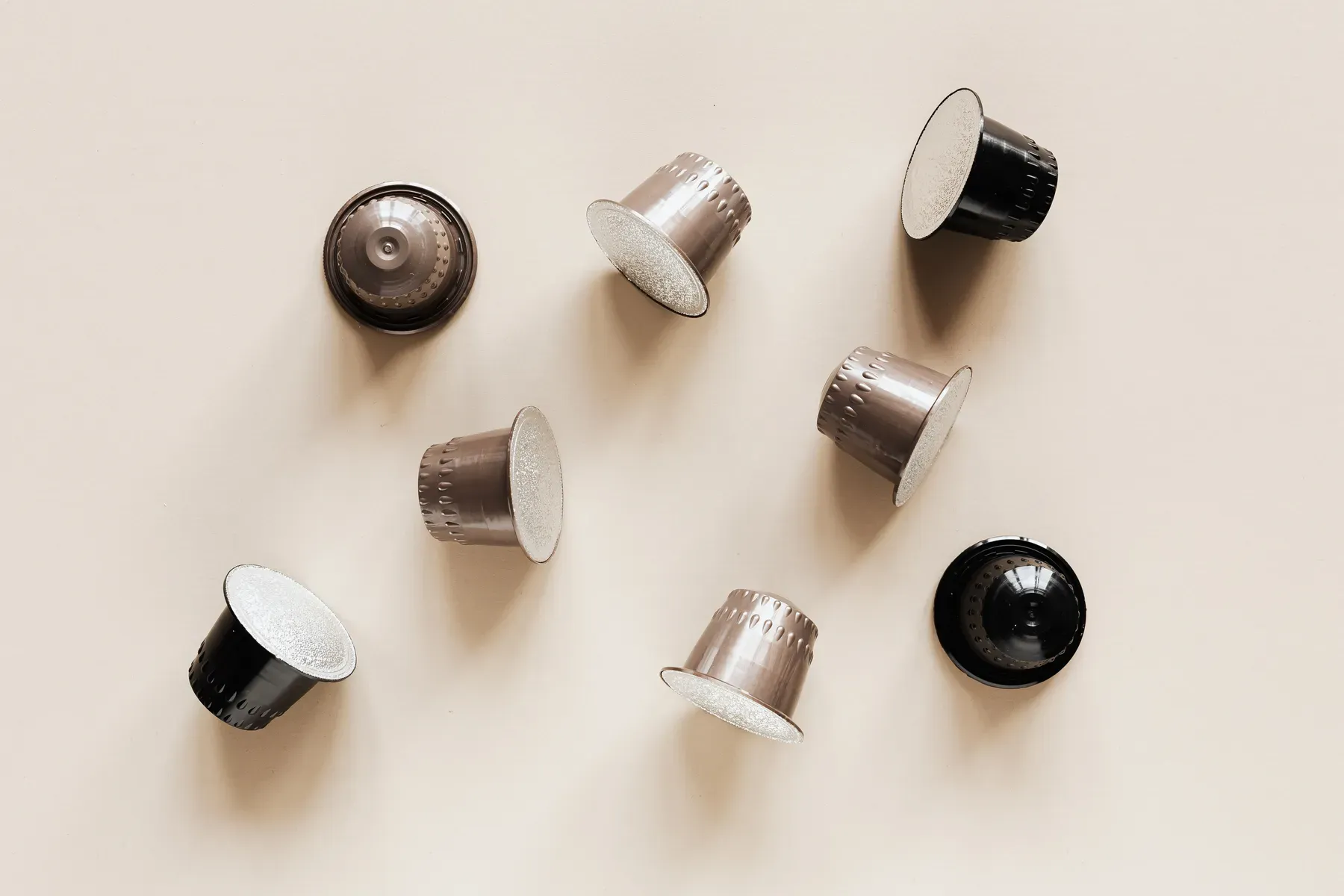
Pods and capsules trade choice for convenience: the coffee, the dose and the grind are decided before the capsule reaches you. The choice that is left is the system, the strength, and what happens to the capsule afterwards. That last part is where the labels need the most reading.
In this guide we set out what to look for, from capsule makers, a trade association, compost certifiers, a US regulator and published research. It gives criteria, not product picks.
What to look for
| Look for | Why it matters | What to check |
|---|---|---|
| The right system for your machine | A capsule only fits the system it was made for, and within one system some sizes fit only newer machines. | The system and machine generation the maker lists for the capsule. |
| Grams of coffee for the cup size | The coffee in the capsule and the water run through it set the strength; running more water than intended thins the cup. | Grams per capsule and the cup size it is made for, on the maker’s page. |
| Intensity read as taste, not caffeine | One maker defines intensity as bitterness, body and roast, not caffeine. | What the maker says its intensity scale measures. |
| Caffeine as a range | Makers give ranges because caffeine varies, and one study of Nespresso capsules measured between half and more than one and a half times Nespresso’s stated values. | The caffeine range per cup, and whether the blend contains robusta. |
| A recycling route where you live | Aluminum and plastic capsules are recyclable only through a take-back scheme or a local program that accepts them. | The maker’s take-back scheme or your local program, and whether it takes this brand. |
| “Compostable” that says which kind | Industrial compost certification assumes a hot, managed facility; home compost certification is a separate, stricter test. | Industrial or home, the certificate named, and whether your area accepts it. |
| A sealed capsule and a best-before date | Oxygen stales coffee; makers seal capsules against light, moisture and oxygen. | A sealed, oxygen-proof capsule and the best-before date on the pack. |
System and strength
The system comes first. Nespresso says its Vertuo and Original capsules will not work in each other’s machines, that capsules made before 2008 cannot be pierced by its newer Original machines, and that some capsule sizes fit only newer machines in the same system. It describes its capsules and machines as one system. Other companies make capsules for some systems; a peer-reviewed study used such capsules alongside paper pods.
Grams and cup size set the strength. Makers state about 5 to 7 g of coffee in espresso and lungo capsules in one system, and 7 to 17 g in another, the larger amounts for mugs and carafes. Nespresso says not to run more than 40 ml through one espresso capsule, and pours a lungo to 110 ml. More water than the capsule was made for gives a thinner cup.
Intensity is not caffeine. Nespresso defines intensity as a combination of bitterness, body and roastiness, not caffeine.
Caffeine comes as a range. Nespresso gives 50 to 100 mg for most of its espressos on one US page, and different ranges on its Canada page, because caffeine varies. A study of Nespresso capsules (Desbrow and colleagues, 2019) measured 19 to 147 mg per serve, between 51% and 162% of Nespresso’s stated values; it covered one maker only. Robusta beans carry about twice the caffeine of arabica, Nespresso says, and cup size matters too. Our caffeine guide compares other brews.
Recycling and compost claims
Recycling depends on where you live. Nespresso says its Original capsules use 80% recycled aluminum, that recycling mostly runs through its own take-back routes, and that its global recycling rate was 33% in 2025. Its scheme is for its own capsules; for another brand, ask that brand. Keurig Dr Pepper says what is accepted differs by US community, runs a take-back where its plastic pods are not accepted, and says acceptance in Canada covered just over a third of people in 2025.
“Compostable” needs a qualifier. Industrial certification, under EN 13432 in Europe or ASTM D6400 for the Biodegradable Products Institute in North America, assumes a managed facility: European Bioplastics gives 50 to 70 °C over 6 to 12 weeks. Home certification is a separate test at lower temperatures, and the Biodegradable Products Institute says home-compostable products must break down within 6 months. TÜV AUSTRIA says items certified for industrial composting should not go in a garden compost. The US Federal Trade Commission’s Green Guides say an unqualified “compostable” claim should be qualified when an item cannot be composted at home or facilities are scarce. The Biodegradable Products Institute notes that 57% of US compost facilities accept yard trimmings only, and that “biodegradable” says nothing useful about disposal.
Freshness can be a trade-off. In a lab study of 23 espresso coffees (Eggermont and colleagues, 2023), the compostable capsule showed a significant drop in aroma intensity compared with aluminum capsules. In another study (Strocchi and colleagues, 2023), roasted and ground coffee stored in standard multilayer packaging with an aluminum barrier and in “eco” capsules kept its phenols and alkaloids fairly stable, but caffeine fell during long storage at 75% humidity compared with 65%, especially in the eco packaging. Both were laboratory studies of specific products, so they do not show that every compostable capsule behaves this way.
Freshness and cost
Nespresso says its sealed capsules are protected from light, moisture and oxygen, and its pages give a best-before of about a year or less. The National Coffee Association says pods keep their freshness until the best-by date.
To compare cost, divide the pack price by the number of capsules: one capsule is one cup. For beans, our cost per cup guide uses bag price ÷ bag weight in grams × your dose. Use the maker’s grams per capsule to compare like with like.
The environmental picture
Life-cycle studies disagree because they measure different things. An Italian study of a 40 ml cup found a moka pot lowest, then a capsule, then a paper pod; it left out growing and roasting the coffee, and the capsule figure rose two to two and a half times with landfill instead of recycling. A German study ranked capsule and fully automatic machines highest, mainly because of standby power, and said habits matter as much as the machine. Researchers in Québec wrote that capsules came out lowest only when people overdose filter coffee, and that convenience can double how much coffee people drink. They found growing the coffee is the biggest source of emissions whatever the method, and suggest checking local recycling or switching to reusable capsules. The dose you use and where the capsule ends up count as much as the capsule.
Common traps
- “Higher intensity means more caffeine.” Intensity describes taste.
- “The caffeine figure is exact.” Nespresso gives ranges, and one study of its capsules found wide differences from the stated values.
- “Compostable means my garden bin.” Industrial-only certificates need a hot, managed facility.
- “Aluminum is recyclable, so every capsule is recycled.” Nespresso reports 33% (2025); it depends on a route that works.
- “Capsules are always worst,” or always best. Studies disagree; dose, habits and waste route matter.
Frequently asked questions
Can I use one brand’s capsules in another system’s machine?
Only if the capsule is made for that system. Nespresso says its two systems’ capsules will not work in each other’s machines, and that its capsules and machines are designed as one system; it does not comment on other brands. Capsules made by other companies for a system do exist, and a peer-reviewed study used some.
How much coffee is in a capsule?
Makers state about 5 to 7 g for espresso and lungo capsules in one system, and 7 to 17 g in another, depending on the cup size. The figures differ a little between a maker’s own country pages, so treat them as a range.
How much caffeine is in a capsule?
Nespresso gives ranges, for example 50 to 100 mg for most espressos on one US page. One study of Nespresso capsules (Desbrow and colleagues, 2019) measured 19 to 147 mg per serve, between 51% and 162% of Nespresso’s stated values. Robusta beans and bigger cups raise it.
Are compostable capsules better?
Only if they reach a facility that composts them. Check whether the claim is industrial or home, and which certificate backs it. In one lab study (Eggermont and colleagues, 2023), espresso made with a compostable capsule had a significantly weaker aroma than espresso made with aluminum capsules. In another (Strocchi and colleagues, 2023), caffeine fell during long storage at 75% humidity compared with 65%, especially in “eco” capsule packaging. Both studies tested specific products.
Do capsules go stale?
Slowly. Makers seal capsules against light, moisture and oxygen and print a best-before date; one maker’s pages give about a year or less. The National Coffee Association says pods keep their freshness until the best-by date.
- Start with your machine’s system: a capsule only fits the system it was made for, and some sizes fit only newer machines.
- Grams per capsule and the cup size set the strength. One maker says not to run more than 40 ml through an espresso capsule.
- Intensity is not caffeine. Nespresso gives caffeine as a range; one study of Nespresso capsules measured 19 to 147 mg per serve.
- Recycling needs a real route: a maker’s take-back scheme or a local program. Nespresso reports a global recycling rate of 33% (2025).
- “Compostable” can mean an industrial facility only. Check which certificate, and whether your area accepts it.
Sources
Pages used for the claims above.
- Nespresso, Vertuo and Original capsules: systems and older capsules.
- Nespresso, Capsule sizes and machines.
- Nespresso, Other brands’ capsules.
- Nespresso, Coffee per capsule and Vertuo grams by size.
- Nespresso, How much water per capsule.
- Nespresso, What intensity means.
- Nespresso, Caffeine per cup and Caffeine (Canada).
- Nespresso, Recycled aluminum, Recycling routes, Recycling rate and Other brands in the scheme.
- Nespresso, Freshness of sealed capsules and Best-before.
- Keurig Dr Pepper, Packaging & Circular Economy: plastic pod recycling.
- Desbrow, Hall and Irwin, Caffeine content of Nespresso pod coffee, Nutrition and Health 25 (2019): Nespresso capsules only.
- Cibelli, Cimini and Moresi, Carbon Footprint of Different Coffee Brewing Methods, Chemical Engineering Transactions (2021).
- Brommer, Stratmann and Quack, Environmental impacts of different methods of coffee preparation, International Journal of Consumer Studies (2011).
- Rodrigues Viana, Marty, Boucher and Dessureault, Here’s how your cup of coffee contributes to climate change, The Conversation.
- Eggermont, Spadafora, Aspromonte and Purcaro, Unraveling the impact of the capsule material on the aroma of brewed coffee by headspace analysis, Analytical and Bioanalytical Chemistry 415 (2023): aluminum, compostable and multilayer capsules.
- Strocchi, Bagnulo, Ravaioli, Pellegrino, Bicchi and Liberto, Evaluation of the behaviour of phenols and alkaloids in samples of roasted and ground coffee stored in different types of packaging: Implications for quality and shelf life, Food Research International 174 (2023): standard multilayer packaging with an aluminum barrier compared with eco capsules.
- US Federal Trade Commission, 16 CFR 260.7: Compostable Claims: compostable claims.
- Biodegradable Products Institute, Biodegradable vs Compostable, Compostability Certification, Composting at home and Learn How Composting Works.
- TÜV AUSTRIA, OK compost HOME.
- European Bioplastics, Organic recycling.
- National Coffee Association, Storage and shelf life.
Published Updated
See sourcesReport a correction — fixes are logged in the Updated date.