
Article
How to Prep an Espresso Puck
Edited and reviewed by Coffee Made Clear TeamUpdated 6 min read
Puck prep takes five steps.
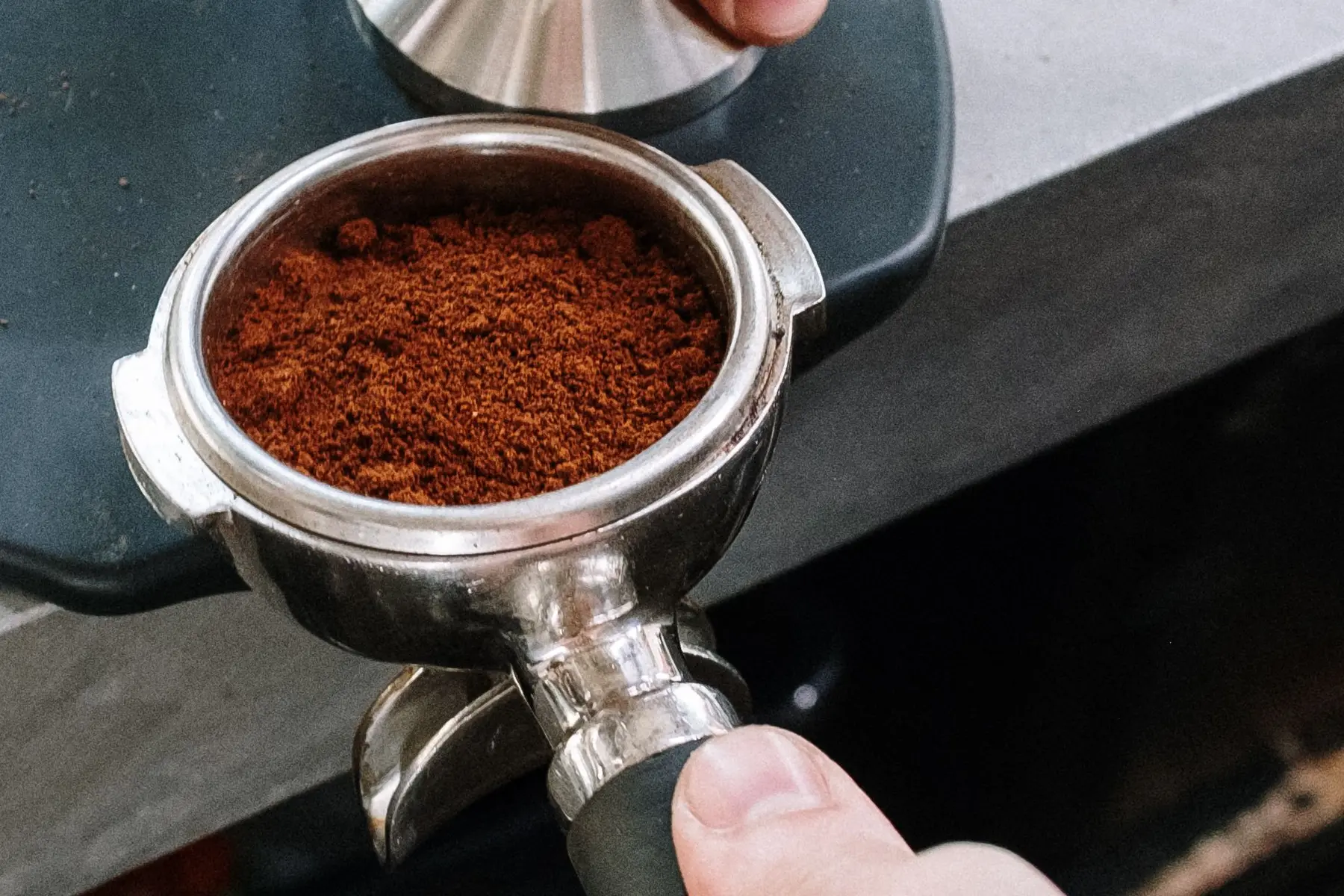
Weigh the dose, break up clumps by stirring with thin needles or tapping the portafilter, level the bed, tamp level and firmly the same way every shot, then brush the rim clean.
Breville suggests about 15–20 kg of tamping pressure but says consistency matters more than the amount.
A 2017 study found pressure made no detectable difference to the caffeine and trigonelline extracted.
The same coffee, grinder and recipe can pull a good shot one morning and a thin, fast one the next. Often the difference is the puck: how the coffee sits in the basket before the water reaches it.
In this guide we walk through puck prep in five steps and show what published research found about stirring tools and tamping pressure. If dose, yield and time are new to you, start with our espresso basics; once the puck is consistent, our dial-in guide shows how to tune the shot.
Why the puck matters
Espresso is made by forcing hot water at high pressure through a compact bed of finely ground coffee. If the bed is even, the water meets every part of it about equally. If it has clumps, loose spots or a tilted surface, the water can run through one part faster than the rest. Baristas call this channeling: some coffee gives up too much, some too little, and the shot can taste sour and bitter at once.
The physics backs the idea. Cameron and colleagues, in a 2020 paper in the journal Matter, found that extraction rose as the grind got finer and then fell again at the finest settings, which they read as a strong sign of uneven flow through the bed. They tied that uneven flow to poor shot-to-shot repeatability and wasted coffee.
Puck prep cannot fix a grind that is far off, but it removes the easy paths, so that the grind is the thing you are changing when you dial in.
What you need
- An espresso machine, its portafilter and a basket.
- A scale that reads to 0.1 g.
- A tamper that fits your basket.
- Optional: a stirring tool with thin needles, or a single needle or opened paper clip.
Puck prep, in order
- Dose
- weigh it, the same dose every shot
- Distribute
- stir out clumps with thin needles, or tap the portafilter
- Level
- a flat bed before you tamp
- Tamp
- level and firm, the same way every time
- Rim
- brush off loose grounds before you lock it in
How hard you tamp matters less than tamping the same way each time.
Step 1: Weigh the dose
Grind into the basket and weigh it. Use the same dose every shot: our espresso basics start at 18 g for a double. A different dose fills the basket to a different height, which changes how the puck behaves, so you cannot judge the rest of your prep until the dose is fixed.
Step 2: Break up the clumps
Fresh espresso grounds clump. Stir through the full depth of the bed with thin needles, in small circles, keeping the point of the needle or paper clip directed away from your hand, until the clumps are gone and the surface looks fluffy. This is the Weiss Distribution Technique (WDT). If you have no needle tool, tap the side of the portafilter several times instead, as Breville’s instructions do, so the coffee collapses and spreads across the basket. The National Coffee Association agrees that the grounds should be evenly distributed in the basket, and says a finger is fine, though tools help.
Step 3: Level the bed
Give the portafilter one or two gentle taps on the counter so the stirred coffee settles flat. The surface should be even from edge to edge, with no mound in the middle and no gap at the side.
Step 4: Tamp level
Set the tamper flat on the bed and press down firmly, keeping it level with the basket rim. Press the same way every shot. Breville’s Bambino manual suggests about 30–40 lb (15–20 kg) as a guide, and says the amount of pressure is less important than using the same pressure every time. The National Coffee Association says tamping packs the grounds into a compact puck, which helps the water reach them more evenly.
Step 5: Clean the rim and lock it in
Brush any loose grounds off the basket rim, so the portafilter seals in the group head, then lock it in and start the shot.
Safety. The portafilter, basket and group head are hot. Hold the portafilter by the handle, and do not force a portafilter that will not release. When you stir, direct the point of the needle or paper clip away from your hand. Follow your machine’s manual.
What published research found
Three published sources bear on puck prep: two studies on extraction, one of them on tamping pressure, and a machine maker’s comparison of stirring methods.
| Source | Kind of source | What it compared | What it found |
|---|---|---|---|
| Kuhn and colleagues, Journal of Food Engineering (2017) | Peer-reviewed study | Espresso from a commercial machine at different particle sizes and tamping pressures, sampled in triplicate | Smaller particles extracted more caffeine and trigonelline. Tamping pressure had no detectable effect. |
| Cameron and colleagues, Matter (2020) | Peer-reviewed study | Extraction against grind setting, with a model and measured shots | Extraction peaked and then fell at the finest grinds, which the authors read as a strong sign of uneven flow. |
| Stéphane Ribes, Decent Espresso (2020) | A machine maker’s comparison, not peer-reviewed | No distribution, swirling the portafilter and raking the surface, against stirring the full depth with 0.7 mm and 0.4 mm needles, with and without taps | Full-depth stirring with 0.4 mm needles plus gentle taps gave the best and most consistent results. Shots with no distribution were sometimes good but less consistent. |
The two studies measured extraction, not taste, and the maker’s comparison used one machine and grinder. Our reading: together they point the same way, that an even bed matters more than a hard tamp.
Where sources agreeHow hard to tamp
The question
Does a harder tamp make better espresso?
What the sources agree on
Breville’s Bambino instruction book says to tamp down firmly, about 30–40 lb (15–20 kg), and that the amount of pressure is not as important as the same pressure every time. In a peer-reviewed study, Kuhn and colleagues found that tamping pressure had no detectable effect on how much caffeine and trigonelline was extracted; particle size did. Neither treats an exact number as critical.
CMC baseline
Tamp firmly and level, inside Breville’s rough range, the same way every shot. If a shot runs fast or slow, change the grind first.
Try it yourself
Pull two shots with the same dose, grind and yield, one tamped lightly but level and one tamped hard. Time and taste both.
See the sources
Troubleshooting
The shot spurts, or runs fast from one side
Water is finding an easy path. Stir out every clump in Step 2, level the bed in Step 3 and keep the tamper flat. If it still runs fast all over, grind finer: our dial-in guide shows how.
Espresso leaks around the portafilter
Breville lists grounds on the basket rim as one cause. Brush the rim clean before you lock the portafilter in, and check that it is fully inserted.
Every shot is different
Fix the dose first, then prep the puck the same way each time. Change one thing per shot, so you can tell what made the difference.
Frequently asked questions
What is WDT?
The Weiss Distribution Technique: stirring the dosed grounds in the basket with a thin needle or a tool of several needles, to break up clumps before tamping. John Weiss shared it online in 2005.
How hard should I tamp espresso?
Firmly and level, the same way each time. Breville’s Bambino manual gives about 15–20 kg as a guide and says consistent pressure matters more than the amount. A 2017 study found tamping pressure had no detectable effect on how much caffeine and trigonelline were extracted.
Do I need a distribution tool?
No. Breville’s instructions tap the portafilter to settle the coffee, and the original technique used a single needle. A tool with several thin needles is quicker; in a machine maker’s comparison, 0.4 mm needles did better than 0.7 mm ones.
Why does my espresso spurt or run fast from one side?
Often the bed was uneven before the tamp, or the tamp was tilted, so water found an easier path through one side. Stir out clumps, level the bed and keep the tamper flat.
Why does espresso leak around the portafilter?
Breville lists coffee grounds on the basket rim as one cause: they stop the portafilter sealing in the group head. Brush the rim clean before you lock it in.
- Puck prep is what you do between grinding into the basket and locking it into the machine: dose, distribute, level, tamp, then clean the rim.
- Clumps and uneven beds can let water run through one part of the puck faster than the rest. Baristas call it channeling.
- Stirring the grounds with thin needles (the Weiss Distribution Technique) gave the most consistent shots in a machine maker’s comparison; a gentle tap also helps.
- Tamp level and firmly. In one study, tamping pressure had no detectable effect on how much caffeine and trigonelline were extracted. Repeat your tamp.
Sources
Studies and pages used for the claims above.
- Breville, The Bambino instruction book (BES450): coffee dose and tamping, and troubleshooting.
- Michael Kuhn, Sandra Lang, Franziska Bezold, Mirjana Minceva and Heiko Briesen, Time-resolved extraction of caffeine and trigonelline from finely-ground espresso coffee with varying particle sizes and tamping pressures, Journal of Food Engineering 206 (2017), 37–47.
- Michael I. Cameron and colleagues, Systematically Improving Espresso: Insights from Mathematical Modeling and Experiment, Matter 2 (2020), 631–648.
- National Coffee Association, Espresso: even distribution and tamping.
- Stéphane Ribes, Decent Espresso, Which puck preparation technique is best? (2020).
- Howard Bryman, Daily Coffee News, What is WDT in espresso? We talked to its creator, John Weiss (2022).
Published Updated
See sourcesReport a correction — fixes are logged in the Updated date.