
Article
Hand Grinders for Filter Coffee
Edited and reviewed by Coffee Made Clear TeamUpdated 6 min read
For filter coffee, a hand grinder needs burrs, not a blade, so the grounds come out more even.
It should reach every size your methods use, from medium-fine for pour-over to medium-coarse or coarse for French press, in steps you can repeat.
After that, check two practical things: it should hold your usual dose in one go, and it should come apart easily for cleaning.
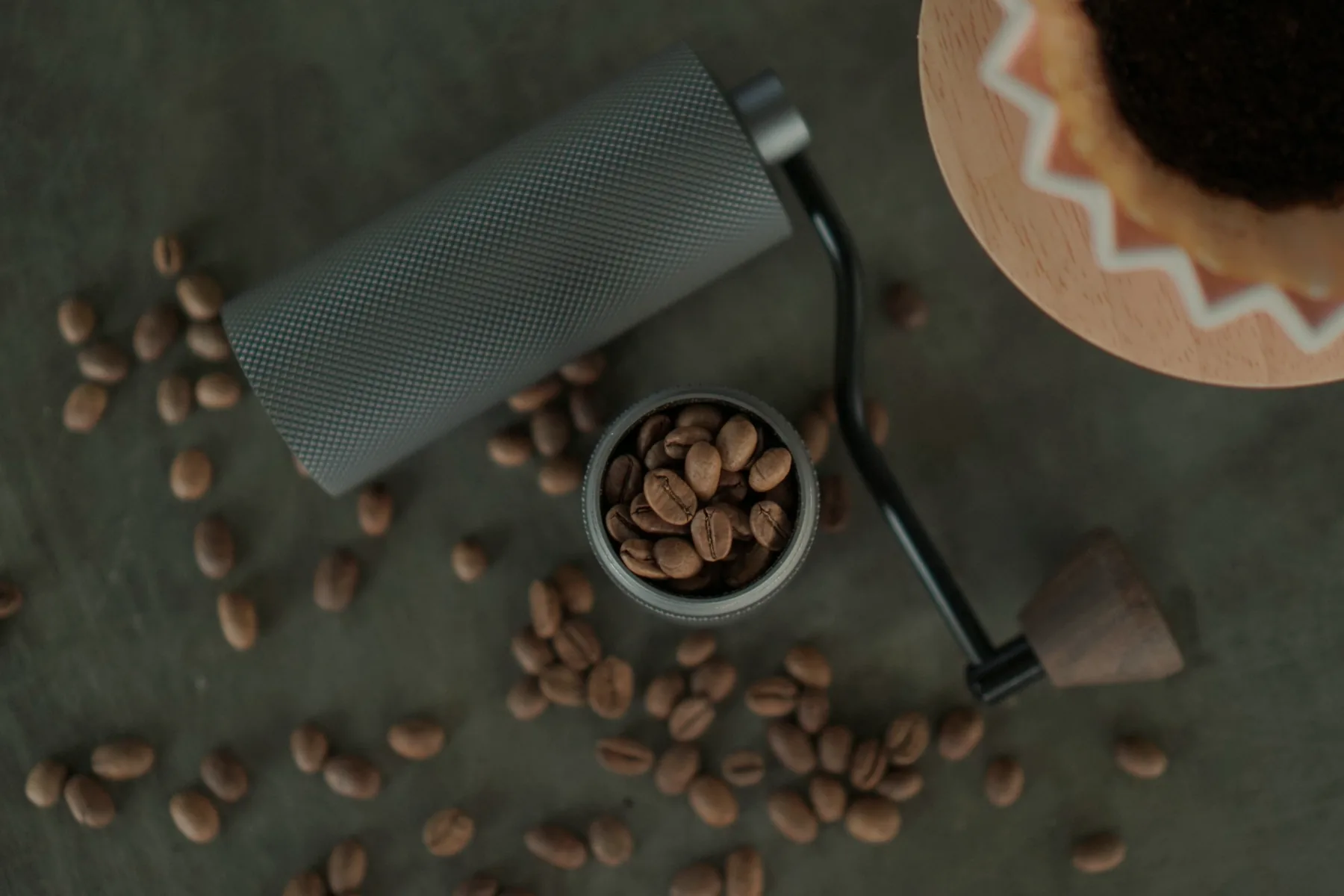
You do not need the fine control that espresso demands.
A hand grinder is a small burr grinder that you turn yourself. For pour-over, drip and French press, it can give you even grounds without a motor. This guide covers what actually matters for filter coffee, so you can judge any hand grinder without a product list. Coffee Made Clear does not recommend specific models. To see what a grinder adds to your cost per cup, use the Cost per Cup calculator, which keeps equipment separate from beans.
What matters for filter coffee
Burrs, not a blade
A burr grinder crushes beans between two burrs, and the gap between them sets the size. A blade only chops. In a 2020 lab test, a blade grinder gave by far the widest mix of particle sizes. Even grounds are easier to brew well, so burrs are the first thing to look for. See burr vs blade grinders explained.
A range that covers your methods
Filter methods start at different sizes. This site’s grind size chart starts a standard cone pour-over recipe at medium-fine, drip at medium, Chemex at medium-coarse and French press at medium-coarse to coarse. A grinder for filter coffee needs to reach that whole span comfortably.
Steps you can repeat
Research describes espresso as the coffee format most open to variation, so filter brewing usually does not need the finest possible control. You need steps that are small enough to fine-tune and easy to come back to. Step size varies a lot: one hand-grinder maker lists clicks from 0.008 mm to 0.025 mm across its own models. See stepped vs stepless grinders explained.
A dose that fits
Check that the bean chamber holds your usual dose in one go. This site’s pour-over and French press recipes each start with 20 g of coffee. If you brew for several people, compare the grinder’s stated capacity with your batch size.
Easy to clean
Burrs should be brushed dry, not washed, unless your manual says otherwise. A grinder that comes apart easily is quicker to clean. See how to clean a coffee grinder.
- 1. Handle: turning it spins the inner burr.
- 2. Bean chamber: holds one dose of whole beans.
- 3. Burrs: an inner burr turns inside a fixed outer burr.
- 4. Adjustment: moves the burrs closer (finer) or apart (coarser).
- 5. Catch cup: collects the grounds; it screws or slides off.
What you need
- A hand burr grinder and its manual.
- A kitchen scale, to weigh each dose.
- Your recipe, such as the pour-over or French press baseline.
- The grind size chart for starting points.
- A note of your settings.
- 1. Fine: espresso.
- 2. Medium-fine: standard cone pour-over recipes, AeroPress, moka pot.
- 3. Medium: automatic drip.
- 4. Medium-coarse: Chemex, and the start of the French press range.
- 5. Coarse: French press and cold brew. French press spans medium-coarse to coarse.
Hand-grinder starting points for filter coffee
- Cone pour-over
- medium-fine
- Drip
- medium
- Chemex
- medium-coarse
- French press
- medium-coarse to coarse
- Dose
- 20 g in this site's pour-over and French press recipes
- Adjust
- one step per brew
Starting points from this site's grind size chart, not settings. One grinder's numbers mean nothing on another, so write down the setting that works for each method.
Step 1: Find zero
Some hand grinders count settings from fully closed. Turn the dial gently until you feel resistance, as your manual describes. Never force the burrs together.
Step 2: Open to a starting point
Use your manual’s chart or the grind size chart for your method.
Step 3: Weigh one dose and grind it
Hold the grinder steady and turn at an even pace.
Step 4: Brew and taste
Note the brew time too.
Step 5: Adjust one step
Thin or sour and fast suggests one step finer. Harsh, drying and slow suggests one step coarser.
Step 6: Record the setting
Write down the method, the coffee and the setting that worked.
Troubleshooting
Grounds stick to the cup and spill
That is static. A very small amount of water on the beans before grinding can cut it sharply, according to research published by the Specialty Coffee Association. Too much water may cause caking or corrosion, so use the least that works.
My pour-over drains much too fast or too slow
Grind is the usual first test. If it races through and tastes thin or sour, go one step finer. If it stalls and tastes harsh or drying, go one step coarser. Change nothing else for that brew.
The grind looks less even than before
Old coffee and oils may have built up on the burrs. Baratza says clean burrs give the most consistent grind. Brush them dry and check they are seated as your manual shows.
Pour-over and French press need very different settings
That is expected. Note both settings, and check the dial each time you switch.
Frequently asked questions
Is a hand grinder good enough for pour-over?
Yes, if it has burrs and reaches a medium-fine setting you can repeat. Research describes espresso as the coffee format most open to variation, so filter brewing usually does not need such fine control. You mainly need even grounds and steps you can return to.
Can one hand grinder do pour-over and French press?
Many can. Check that its range reaches from medium-fine for pour-over to medium-coarse or coarse for French press. Write down the setting for each method, because one grinder's numbers mean nothing on another.
How many grams should a hand grinder hold?
Enough for your usual dose in one go. This site's pour-over and French press recipes each use 20 g of coffee. If you brew larger batches, check the stated capacity against your dose.
Do I need a stepless hand grinder for filter coffee?
No. Stepless control matters most for espresso. For filter coffee, clear steps that are not too large are easier to repeat. If your grinder is stepless, mark or note your setting.
- Look for burrs, not a blade, so the grounds come out more even.
- The range should reach from medium-fine for pour-over to medium-coarse or coarse for French press.
- Filter coffee does not need the fine control espresso demands. You need steps you can repeat.
- Start from the chart, change one step per brew, and record the setting that works.
Sources
Studies and pages used for the claims above.
- Howard Bryman, Equipment Report: Four Mid-Range Burr Coffee Grinders Tested & Reviewed, Coffee Review (2020).
- National Coffee Association, How to Make Drip Coffee: grinders, About Coffee.
- 1Zpresso, Coffee Grind Size Chart for 1Zpresso Manual Coffee Grinder. Used only for published step sizes and the zero-point method.
- Baratza, Stepped vs. Stepless: Which is Right for Your Grind?.
- Cameron et al., Systematically Improving Espresso: Insights from Mathematical Modeling and Experiment, Matter (2020).
- Baratza, Encore Owner’s Manual (revision 5/2014), care and cleaning section. Used for its note that clean burrs give the most consistent grind.
- Joshua Méndez Harper and Christopher H. Hendon, It’s Electric: Understanding and Reducing Static Electricity During Grinding, Specialty Coffee Association.
Published Updated
See sourcesReport a correction — fixes are logged in the Updated date.