
Article
How to Taste Coffee at Home
Edited and reviewed by Coffee Made Clear TeamUpdated 7 min read
Brew two coffees side by side in cups, 8.25 g per 150 ml, with water at about 93 °C.
Smell them, break the crust after 3 to 5 minutes, then slurp from a spoon several times as they cool.
Note acidity, sweetness, body, bitterness and finish, and name flavors with the flavor wheel from the center outward.
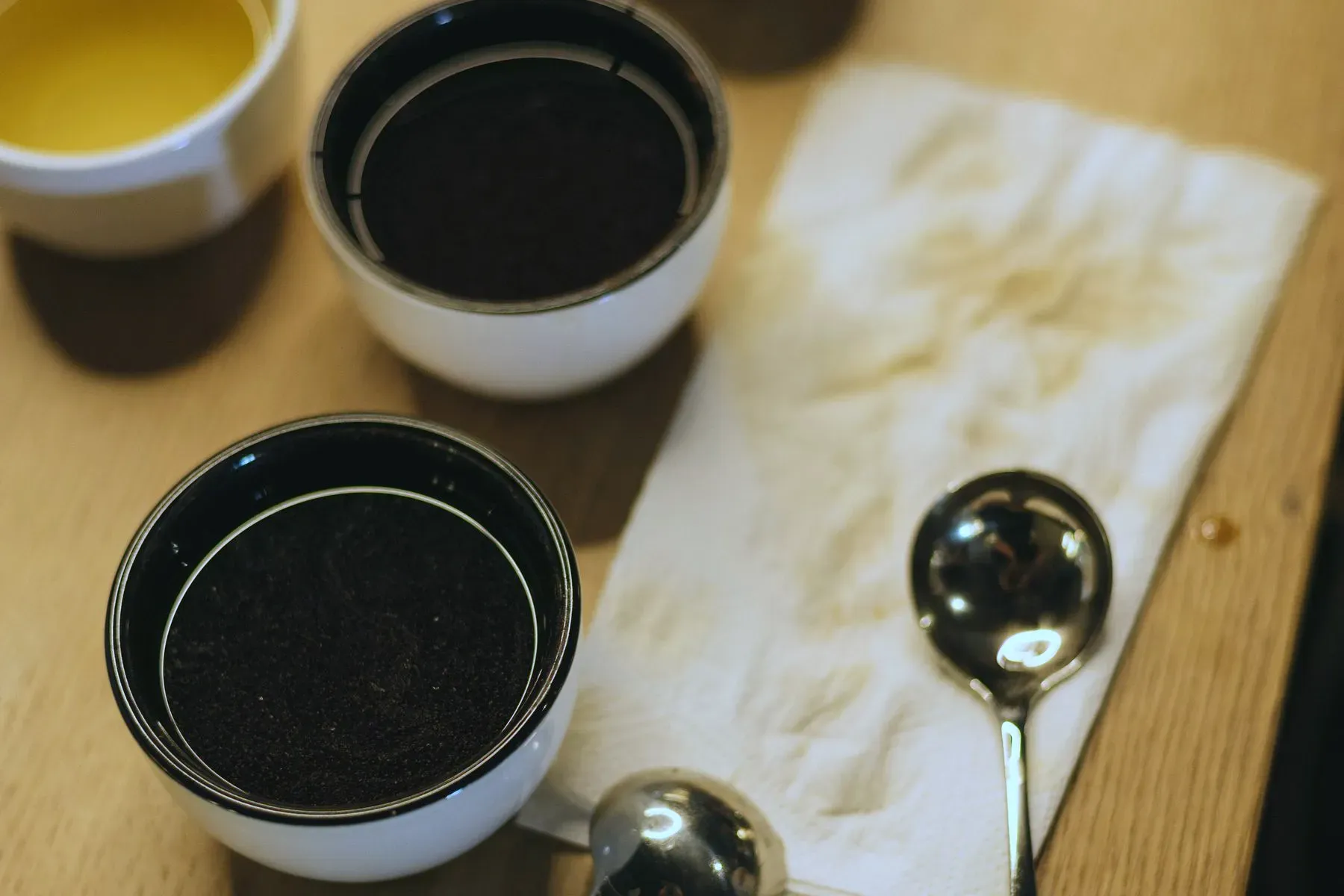
Tasting coffee well is a skill, and like any skill it improves with a simple, repeatable method. The trade’s method is cupping: ground coffee and hot water steeped in a cup, no filter and no equipment beyond a spoon. It works just as well on a kitchen counter.
In this guide we adapt the Specialty Coffee Association’s cupping standard for home, with help from World Coffee Research’s sensory lexicon, the flavor wheel and published research on how we taste coffee.
What you need
- Two or more coffees to compare, whole bean if you can
- A grinder and a scale; our guides to choosing a scale and a grinder can help
- A cup or bowl for each coffee, all the same size
- A kettle, a spoon for each taster, a glass of hot water to rinse the spoon, and paper for notes
| Coffee | 8.25 g per 150 ml of cup, ground slightly coarser than drip |
|---|---|
| Water | 93 °C, give or take 3 °C, poured to the rim |
| Wait | 3 to 5 minutes, then break the crust |
| Taste | from about 70 °C, at least three times as it cools |
| Compare | two or more coffees side by side |
Weigh the water a cup holds to the rim to find its capacity.
Step 1: Weigh and grind
Find each cup’s capacity by weighing the water it holds to the rim. Use 8.25 g per 150 ml of cup, ground slightly coarser than drip: that is the Specialty Coffee Association’s ratio, and its grind is a little coarser than paper-filter drip. Grind as close to tasting as you can. A roaster’s home guide gives the same ratio as 0.055 g per ml, so a 200 ml bowl takes 11 g.
Step 2: Smell the dry grounds
Before any water goes in, smell each cup. The Specialty Coffee Association calls this the fragrance, and it is your first clue to how the coffees differ.
Step 3: Pour, wait, and break the crust
Pour water at 93 °C, give or take 3 °C, poured to the rim of each cup. The grounds form a crust on top. Wait 3 to 5 minutes, then break the crust: stir it about three times while you smell the aroma that rises, then skim off the grounds and foam. Rinse your spoon in hot water between cups.
Step 4: Slurp as it cools
Taste from about 70 °C, at least three times as it cools. Slurp from the spoon so the coffee sprays across your tongue and the roof of your mouth; you can spit if you want less caffeine. A peer-reviewed study found sour and sweet notes stood out at 31 to 44 °C, and roasty and bitter notes at 50 to 62 °C, so the same coffee changes as it cools.
Step 5: Compare, then write it down
Taste two or more coffees side by side at the same stage, going back and forth. A roaster’s home guide says side-by-side tasting helps you detect differences. Write notes as you go, and keep your impressions to yourself until everyone tasting has finished.
What to taste for
Take one attribute at a time. The Specialty Coffee Association and World Coffee Research define them like this:
- Aroma: what you smell from the brewed cup.
- Flavor: taste combined with the smell that reaches your nose from the back of your mouth as you breathe out.
- Acidity: a perceived sourness, which can be bright and pleasant or sharp.
- Sweetness: which you can taste and also smell.
- Body: the weight and texture in your mouth. The Specialty Coffee Association calls it mouthfeel; World Coffee Research’s lexicon uses fullness and thickness.
- Bitterness: one of the basic tastes. It is not scored on its own in the Specialty Coffee Association’s cupping form, but it is worth noting.
- Finish: what lingers after you swallow or spit, and for how long. The Specialty Coffee Association calls it aftertaste.
A strong impression is not the same as a good one: the Specialty Coffee Association says intensity does not imply quality. If the basic tastes are hard to tell apart, it suggests practicing with simple solutions of sugar, salt and citric acid in water.
Naming flavors
The Coffee Taster’s Flavor Wheel, built from World Coffee Research’s lexicon of 110 attributes, puts general words in the center and specific ones on the outer ring. The Specialty Coffee Association’s advice is to start at the center and work outward, stopping wherever you are confident, then go back to the center for the next note. Neighboring words on the wheel are closely related. Professional panels train for months, so a general word such as fruity or roasted is a fair result at home.
Comparing one change at a time
The same method compares roasts, brewers or recipes, as long as you change one thing. For brewed coffee instead of cupping, the Specialty Coffee Association suggests about 55 to 60 g of coffee per liter, and still recommends slurping from a spoon. The National Coffee Association notes that roast names vary between roasters, and that lighter roasts taste more acidic and darker roasts more bitter. Research found that sweetness falls as a brew gets stronger, so match the strength when you compare. Our guides to roast levels and origins and flavor give you pairs worth comparing.
Control what you can. Use clean, filtered water; the National Coffee Association says to avoid distilled or softened water. A green-coffee importer’s cupping guide suggests avoiding strong smells and flavors before you taste, and coding the cups so you don’t know which is which. World Coffee Research notes that panels taste only four to six samples in a session to avoid fatigue.
Common traps
- “Taste happens on the tongue.” Flavor includes smell from the back of the mouth; slurping helps the aroma reach your nose.
- “Tasting once, hot, is enough.” The cup changes as it cools; taste at least three times.
- “The most intense coffee is the best.” Intensity is not quality.
- “Use the most specific word.” Stop at the level you are sure of.
- “Every cupping guide uses the same numbers.” Older guides may quote slightly different ones, such as 4 minutes or 200 °F; this guide follows the Specialty Coffee Association’s 2024 standard, which replaced its 2004 protocol.
Frequently asked questions
What ratio should I use to cup at home?
The Specialty Coffee Association uses 8.25 g of coffee per 150 ml of cup capacity, measured to the rim. A roaster’s home guide puts it as 0.055 g per ml, so a 200 ml bowl takes 11 g.
Do I have to slurp?
It helps. The Specialty Coffee Association says to slurp a spoonful so the coffee covers as much of the tongue and upper palate as possible, and to slurp even when tasting brewed coffee, because it carries the aroma to the back of the nose.
What is the difference between aroma and flavor?
Aroma is what you smell through your nose from the brewed cup. Flavor is what you taste combined with the smell that reaches your nose from the back of the mouth while the coffee is in it.
How do I use the flavor wheel?
Start at the center, with general words such as fruity or sweet, and move outward to more specific words only as far as you are confident. Then go back to the center for the next note.
What water should I use, and how do I keep my palate fresh?
Use clean, filtered water: the National Coffee Association says to avoid distilled or softened water. Avoid strong-flavored food before you taste, rinse your spoon in hot water between cups, and keep to a few coffees at a time.
- Cupping is the trade’s simple way to taste: ground coffee and hot water in a cup, no filter. The Specialty Coffee Association uses 8.25 g per 150 ml of cup.
- Taste two or more coffees side by side; differences stand out when you can go back and forth.
- Flavor is taste plus smell. Slurping sprays the coffee across your mouth and carries its aroma to the back of your nose.
- Taste at least three times as the cup cools: in one study, sour and sweet notes stood out cooler, roasty and bitter notes hotter.
- Name flavors from the center of the flavor wheel outward, and stop at the level you are sure of.
Sources
Pages used for the claims above.
- Specialty Coffee Association, SCA Standard 102-2024 Coffee Value Assessment: Sample Preparation and Tasting Mechanics: ratio, grind, water, crust, slurping and attributes.
- Specialty Coffee Association, SCA Standard 103-2024 Coffee Value Assessment: Descriptive Assessment: acidity, sweetness, intensity and basic tastes.
- Specialty Coffee Association, How to Use the Coffee Taster’s Flavor Wheel in Eight Steps.
- World Coffee Research, Sensory Lexicon and Sensory Lexicon 2.0.
- Spencer, Sage, Velez and Guinard, Using Single Free Sorting and Multivariate Exploratory Methods to Design a New Coffee Taster’s Flavor Wheel, Journal of Food Science (2016).
- Steen and colleagues, Influence of serving temperature on flavour perception and release of Bourbon Caturra coffee, Food Chemistry (2017).
- Frost, Ristenpart and Guinard, Effects of brew strength, brew yield, and roast on the sensory quality of drip brewed coffee, Journal of Food Science (2020).
- National Coffee Association, Roasts.
- National Coffee Association, Drip coffee: water.
- Royal Coffee, Cupping Protocols & Procedures.
- Five Senses Coffee, Cupping Coffee at Home.
Published Updated
See sourcesReport a correction — fixes are logged in the Updated date.